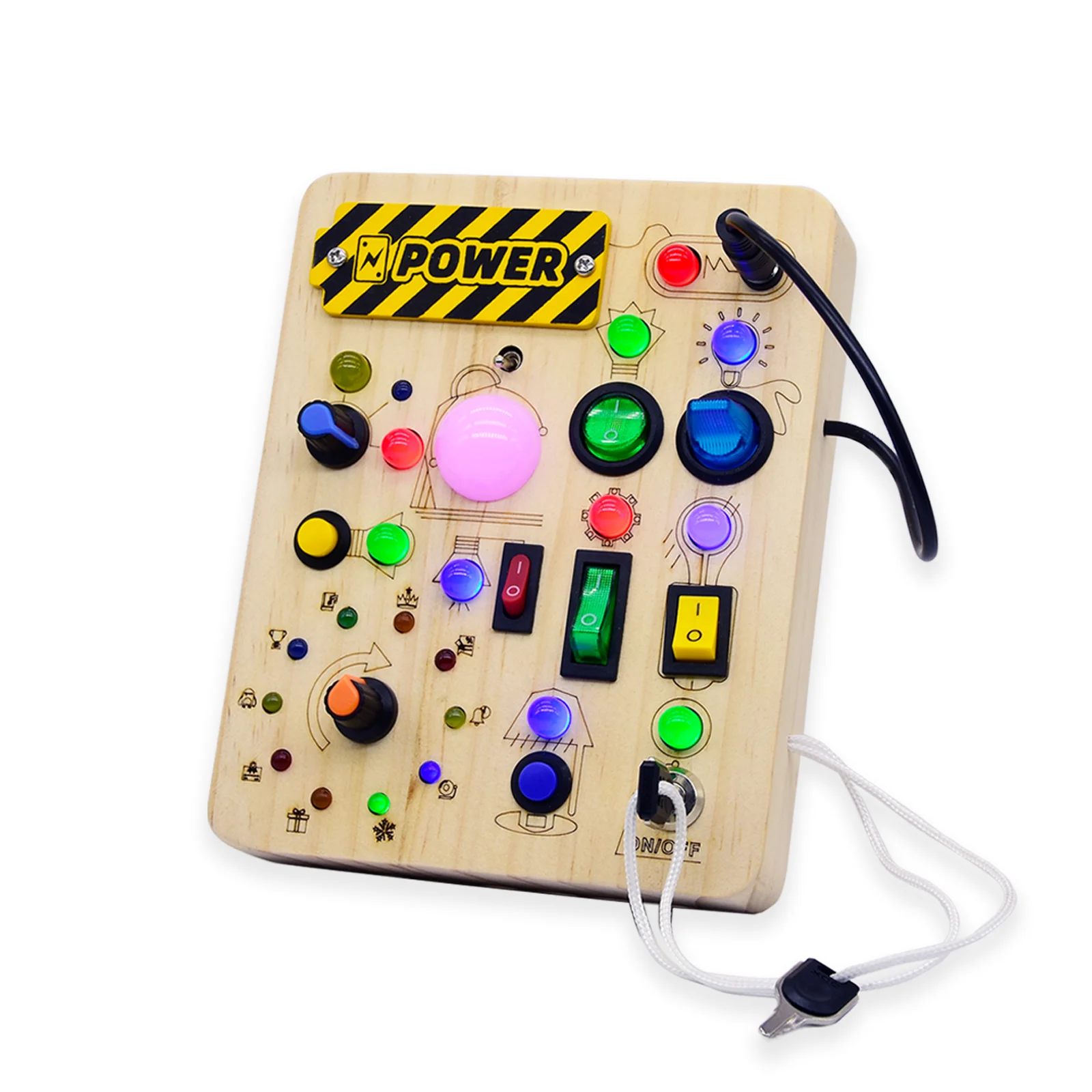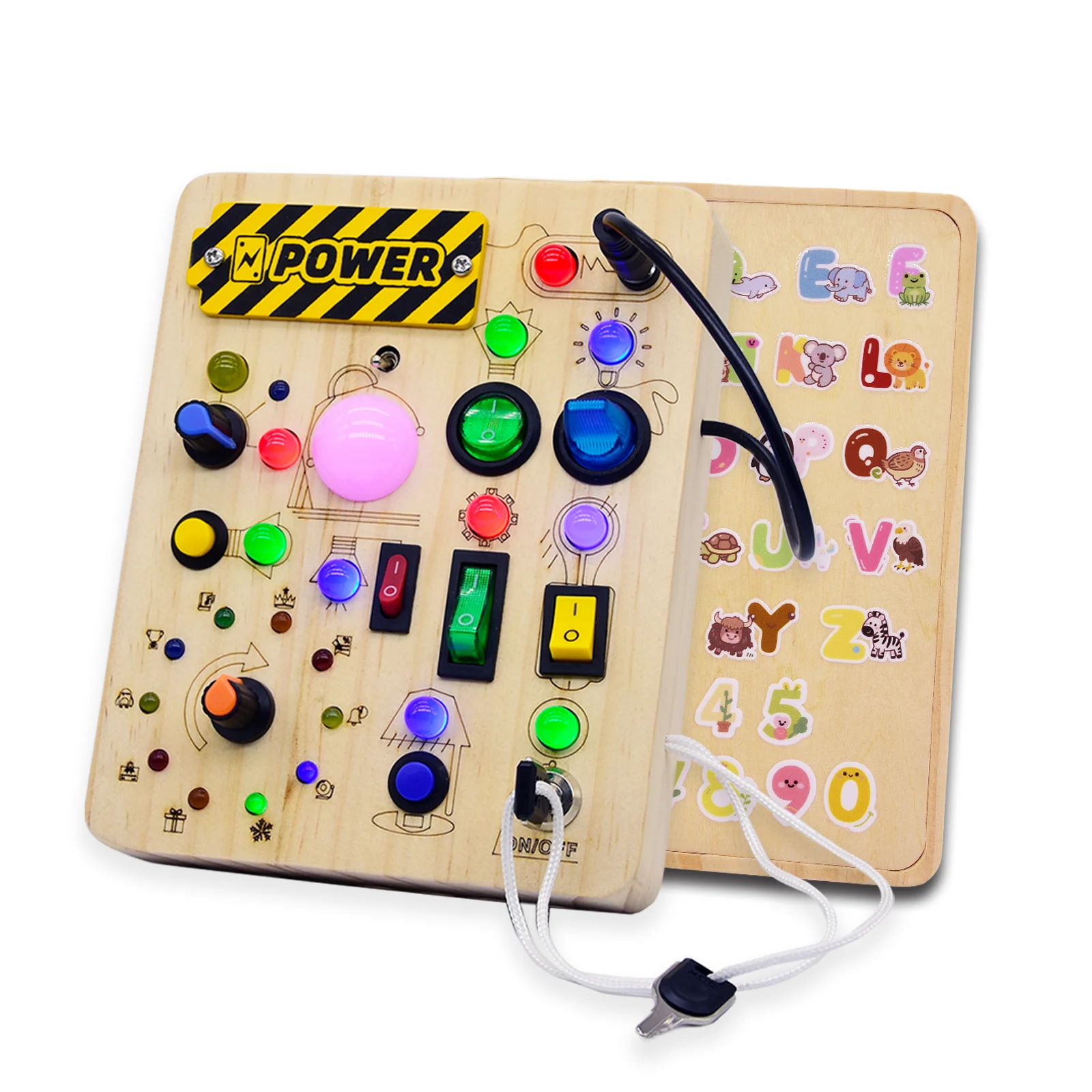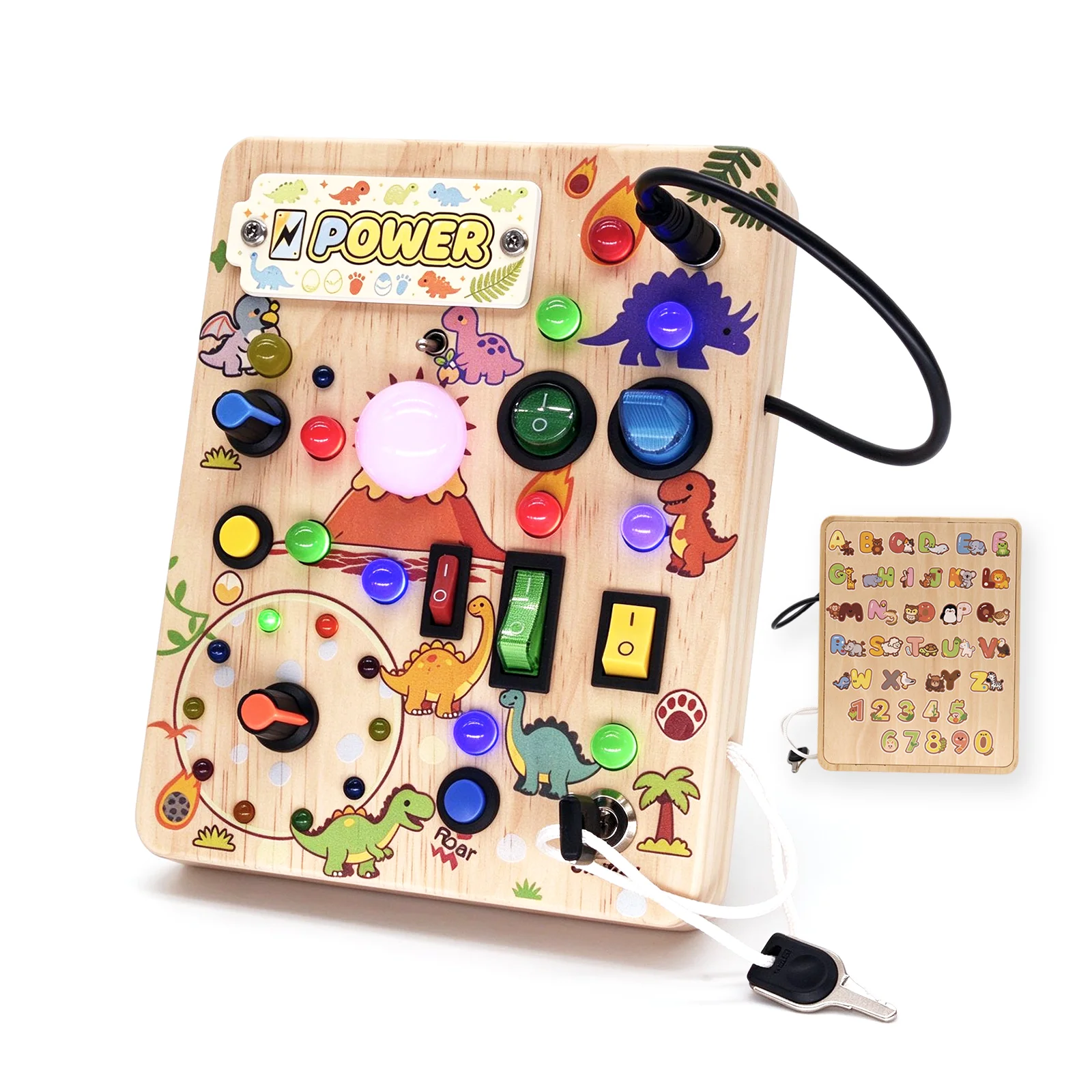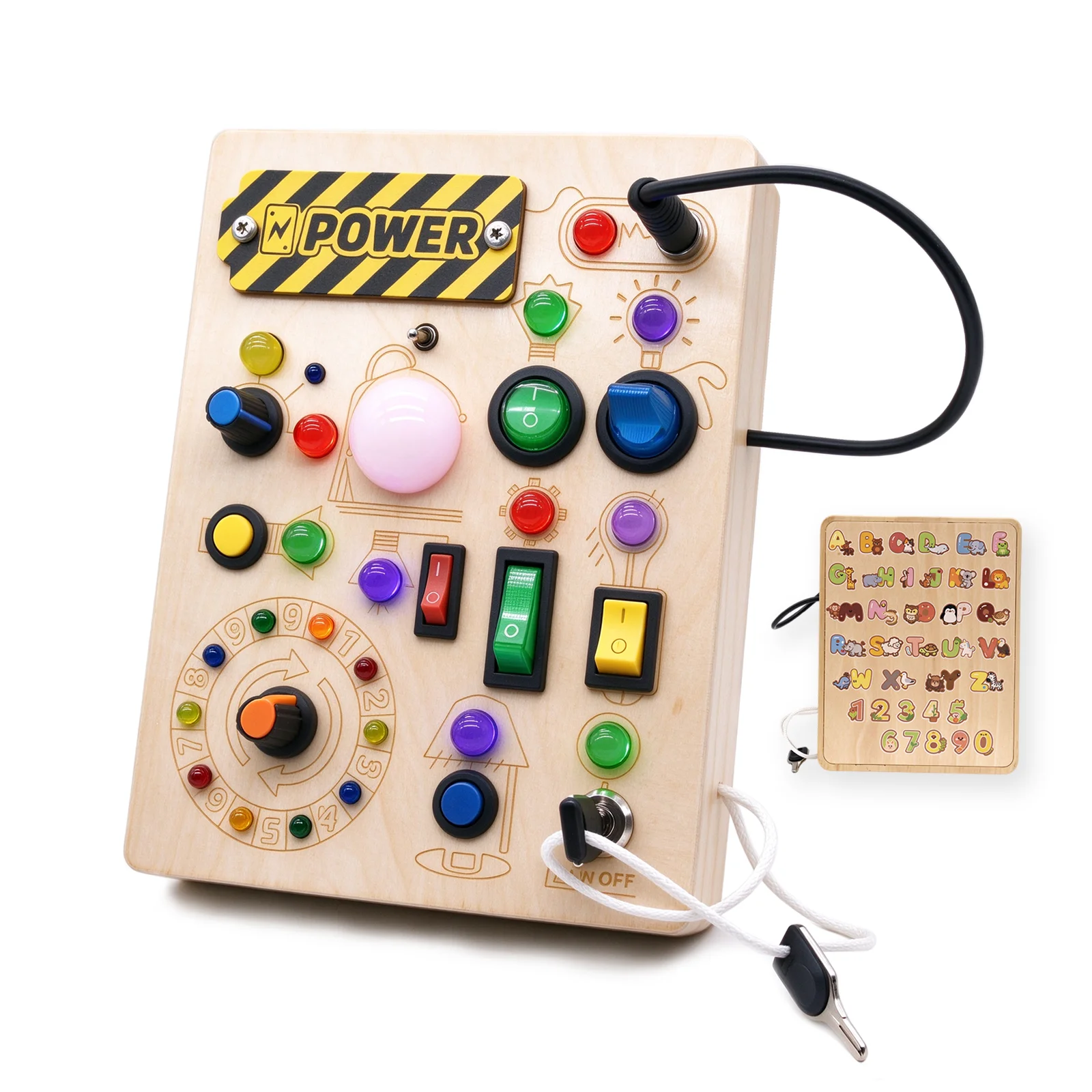
Short answer: when two factories quote you $5.20 and $9.10 for "the same" busy board, they are not quoting the same board. The gap almost always sits in four places — the light system, the wood, how many switches are on the front, and what the number does or doesn't include. Everything below comes from our own line in Wenzhou, so read it knowing we're the factory and we have an obvious interest in you paying for the parts that matter.
Our range sits at $8.90–$9.50 FOB at 100 pieces. Boards at $4–5 are real too. Both prices exist, and both get shipped. The question worth asking isn't which one is cheaper. It's which one is still being quoted to you on the third order.
Quick facts
- MOQ: 100 pcs per model from the catalogue · 200 pcs for your own artwork or engraving · 500–1,000 pcs for full OEM
- Samples: 1–10 pcs, 3–7 days, cost credited back against the bulk order
- Lead time: 15–25 days after deposit and artwork approval
- Certifications: CE / CPC / ST reports on current models (tested to EN 71 and ASTM F963)
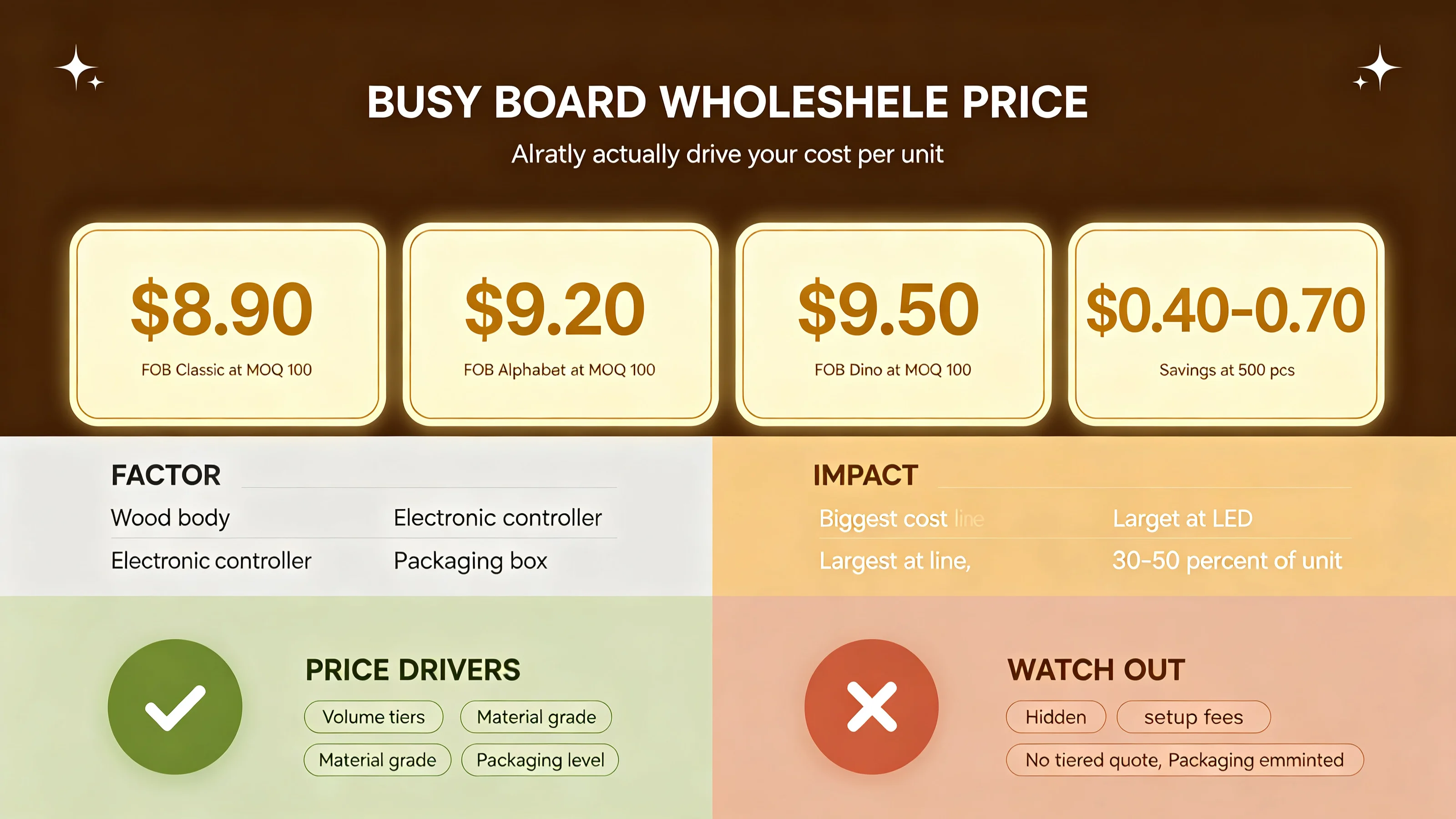
- FOB at MOQ: $8.90 Classic · $9.20 Alphabet · $9.50 Dino
- Recommended retail: $20–35
Why the same board gets four different quotes
Send the same photo and spec sheet to eight suppliers and you'll get eight numbers. We see buyers do this constantly, and the spread is usually wider than they expect — sometimes more than double.
Most of that spread is not greed and not a scam. It's four decisions made differently:
- What "light-up" means. A board with three hard-wired bulbs and a board with a controller that reads switch positions and runs 23 modes are both described as "LED busy board" on Alibaba. They are not the same product.
- What the wood is. Solid pine or beech, sanded and rounded, versus an 18 mm plywood core with a veneer. From the front, in a photo, they look identical. In a nursery they don't.
- How many switches. A 6-switch board and a 12-switch board differ in cost, in play time, and in how often the thing gets returned as "boring."
- What's in the number. FOB vs CIF. Box or no box. Certification reports included or "you pay for testing." Deposit terms. Packaging that survives a container or packaging that survives a courier.
Buyers who optimise only on line one — the photo — end up comparing prices for products that were never the same to begin with.
Where the money actually goes
Here's our own cost structure on a Classic board at 100 pieces, rounded to the nearest half percent. Numbers like this are the fastest way to tell whether a quote is real: any factory that's actually manufacturing can break it down without stopping to think.
| Cost block | Share of FOB | What moves it |
|---|---|---|
| Wood, sanding, CNC work | ~22% | Solid wood vs plywood core; edge radius; board size |
| Electrical: switches, LEDs, board, battery box | ~28% | Number of switches; controller vs fixed bulbs; battery box design |
| Assembly and testing | ~19% | Switch count; how much of the light function is tested per unit |
| Packaging | ~7% | Plain white box vs printed colour box; inner tray; manual |
| Certification amortisation | ~3% | Whether the model already has current reports or needs new testing |
| Factory overhead and margin | ~13% | Order size; payment terms; how much rework the batch needs |
| Freight and duties | not included | Depends on Incoterm — this is why FOB and CIF quotes aren't comparable |
Two things to notice. First, electronics are the single biggest block — almost a third of what you pay. Second, that block is also the one a cheap quote cuts first, because you can't see it in a product photo.
The five levers that move your unit price
1. The light system
This is the biggest single swing, and it's usually worth $1.50–2.00 per unit.
A fixed-bulb board runs 1–3 LEDs wired straight to specific switches. One colour, no logic, nothing happens when a child flips a switch that isn't wired. The board with a controller reads what's been toggled and responds — different colours, sequences, sometimes a short light pattern. We put the two systems side by side in LED vs traditional busy boards. That's the difference between a toy a child puts down in ninety seconds and one that keeps pulling them back.
Parents buy minutes of play. A mode set is how you sell minutes. If you're competing on shelf against a board that lights up in six colours, a three-bulb board at $4 less isn't a bargain, it's inventory.
2. The wood
Solid wood versus a plywood core with a veneer is roughly a $0.80–1.20 difference per unit. Both pass a photo test. Only one passes a smell test, a drop test, and a "does the corner still have its edge after six months" test.
This matters more than buyers expect because returns are the hidden cost. A board that arrives smelling of glue, or chips at the corner, costs you the shipping both ways, the customer, and any review they leave. We've had buyers come to us after a season of cheap boards specifically because their return rate had eaten the margin they thought they'd saved.
3. Number and mix of switches
Twelve switches versus six is roughly $0.60–0.90. Adding a rotary dial or a rocker in place of another toggle costs a little more than adding another toggle, but it changes how long the board holds attention.
The mix matters as much as the count. Four switches that all feel the same get learned once and abandoned. A toggle, a rocker, a push button, and a rotary dial give four different hand movements, and that variety is what keeps a two-year-old coming back. If a quote's spec sheet lists a switch count but not a switch type, ask for the breakdown before you compare it to anything.
4. What the price includes
This is where honest quotes and cheap quotes stop being comparable at all. Ask every supplier these four questions and write the answers in one column:
- Is this FOB or CIF, and which port?
- Is packaging included, and which kind — plain box or printed?
- Are the CE / CPC / ST reports included, and is the model number on them the model you're buying? (what each mark actually covers)
- What are the payment terms, and does the price change if terms change?
A supplier quoting $6.20 FOB with a plain box and no certification paperwork is often more expensive than one quoting $8.10 with a printed box, current reports, and 30/70 terms. Same board, different bundle.
5. Order size and payment terms
Bigger orders get a better per-unit price, but the curve flattens faster than most buyers assume. Going from 100 to 500 pieces typically saves $0.40–0.70. Going from 500 to 1,000 saves maybe another $0.20–0.30. Below 100, prices climb steeply because setup, artwork plates, and the sample run get spread over fewer units.
Payment terms move the number too. 30% deposit with the balance before shipment is our standard and what our pricing assumes. If you ask for open account or a longer balance window, expect either a higher unit price or a polite refusal — a factory carrying your money for 60 days is lending you working capital, and it prices that in whether it says so or not.
The MOQ effect: what volume actually buys
Buyers often treat MOQ as a hurdle to argue down. It's more useful to think of it as a price curve — the longer version of this sits in our MOQ, pricing and lead time guide.
| Quantity | Typical FOB (Classic) | What you're buying |
|---|---|---|
| 50 pcs | not quoted | Below setup cost — most factories decline |
| 100 pcs | $8.90 | Setup, plates and sample run spread over the minimum viable batch |
| 200 pcs | ~$8.40 | Custom artwork or engraving becomes economic |
| 500 pcs | ~$8.20 | Full OEM packing, own barcode, private label |
| 1,000 pcs | ~$7.90 | Best per-unit price on this platform |
| 3,000+ pcs | quoted per order | Container-scale; price negotiated with freight and schedule |
Two caveats we tell every buyer. First, if you're not sure the product sells, order 100 and test it — the $0.70 you'd save at 500 isn't worth sitting on 400 boards you can't move. Second, the difference between 500 and 1,000 is smaller than most people plan around. If capital is tight, buy 500 twice rather than 1,000 once.
What a very cheap quote usually cut
When a quote comes in at $4–5, it's worth knowing what's missing rather than assuming the supplier is lying. Common answers, roughly in order of frequency:
- Fixed bulbs instead of a controller. The single most common cut. Invisible in a photo.
- Plywood core with veneer. Sometimes sold honestly as "engineered wood."
- Fewer switches, all the same type. A spec sheet that says "busy board, wooden, light-up, 30×40 cm" and nothing else.
- No certification paperwork. "We can test it if you need it" — which means the model you're buying hasn't been tested.
- Plain box, no inner tray. Fine for your own warehouse, bad for retail.
- Payment before production, 100%. Cuts the factory's risk, and yours goes up.
- Last year's design. Still works. Still sells, at the right price.
None of these is automatically fatal. A plywood board with fixed bulbs at $5 can be a perfectly good entry SKU, as long as you know that's what you bought, you price it accordingly, and you don't market it as the same thing as a $9.50 board. The expensive mistake isn't buying cheap. It's buying cheap and pricing it like it's premium.
Our prices, on the record
Three models — the Classic, Alphabet and Dino — one platform, differing by artwork and back panel:
| Model | FOB at MOQ 100 | Switch count | Retail target |
|---|---|---|---|
| Classic | $8.90 | 12 mixed | $20–25 |
| Alphabet | $9.20 | 12 mixed | $22–28 |
| Dino | $9.50 | 12 mixed | $25–35 |
All three run the same controller with 23 lighting modes and take 2 × AAA batteries, which we deliberately ship without — adding cells means a dangerous-goods classification and paperwork that costs more than the batteries.
At MOQ 100 with standard packaging, these prices hold. Custom printing, your own barcode, or private labelling starts at 200 pieces and adds $0.20–0.50 depending on the box.
From FOB to landed cost: what the price tag doesn't show
Everything above is FOB — the board sitting on the dock at Ningbo or Shanghai. What reaches your warehouse costs more, and the gap is often wide enough to change which supplier is actually cheaper.
| Cost block | Typical | Notes |
|---|---|---|
| FOB unit price (Classic, 500 pcs) | ~$8.20 | What the factory quotes |
| Sea freight, LCL | $0.40–0.70 per unit | Falls hard once you fill a container |
| Import duty, US (HTS 9503.00.00) | check current rate | Toys are low-duty, but China-origin treatment has changed repeatedly |
| Import duty, EU | 0–4.7% | Depends on classification and origin paperwork |
| VAT / sales tax | 19–21% (EU) | Recoverable if you are VAT-registered |
| Port, clearance, documentation | $80–250 per shipment | Fixed, whatever the order size |
| Indicative landed cost | $9.60–10.80 per unit | Roughly 15–25% above FOB |
Three things this table is telling you.
Freight is not the enemy at volume. At 500 pieces the freight line adds under 8% to unit cost. At 100 pieces, shipped the same way, it can add 20%. If your first order is small, expect that line to look alarming, and expect it to fall on the second order — not because anyone renegotiated, but because you bought more.
Duty is usually not the problem; paperwork is. Wooden toys sit in a low-duty classification in both the US and the EU. The importers who get surprised are usually the ones whose supplier wrote "wooden decoration" on the invoice to shave a cost, and who then spent three weeks in a customs dispute that cost more than the duty ever would have.
Fixed costs scale down; variable costs do not. Port fees, clearance and documentation are charged per shipment. Unit freight is charged per unit. The first is brutal at 100 pieces and irrelevant at 3,000.
The practical consequence: when a $6.50 quote and an $8.90 quote are on your desk, convert both to landed cost before you decide. A supplier $2.40 cheaper on FOB, shipping in a way that adds $1.10 per unit in freight and clearance, has narrowed the real gap to $1.30 — and you still have not priced the certification paperwork.
For the shipping and packaging side in detail, see our packaging and shipping guide. For the import process itself, start with how to import busy boards from China.
How to compare quotes without getting lost
When you have several quotes on the table, don't sort them by the first number. Put them side by side against the same questions, and the real cheapest usually changes position.
- Normalise the Incoterm. Convert everything to FOB same-port before you compare a single figure.
- Write the spec in one line per supplier. Wood type, switch count and mix, light system, board size. Anything a supplier can't answer, mark as unknown — an unknown is a risk, not a cost saving.
- Ask for the certification report PDF, and check the model number and date. A report for a different model is worth nothing.
- Ask what the sample costs and whether it's credited. We credit it against the bulk order; that's a signal about how they treat the relationship.
- Ask about lead time and what happens if it slips. 15–25 days is our normal. A quote with a suspiciously short lead time in peak season usually means someone else's order gets pushed to make room for yours.
- Price the packaging separately. A printed box with a tray can add 30–50% to a white box. Know that number before you decide.
Do this once and you'll usually find your "cheapest" quote and your "safest" quote are the same one. The longer version of that exercise is in how to choose a busy board supplier.
Questions buyers ask us every week
Why is this $9.50 when I found the same thing for $4.80? Because it isn't the same thing. Ask the $4.80 supplier what the light system is, what the wood is, how many switches, and whether certification reports exist for the model. If they can answer all four and the price holds, buy it. In our experience they usually can't.
Will the price change if lumber goes up? For a confirmed order with a deposit, no — the price is locked. For a quote we're holding for a future order, we may revise it if material moves a lot. Nobody can honestly hold a raw-material price for six months.
Can I get the 1,000-piece price at 300 pieces? No, and a supplier who says yes is either quoting high elsewhere or planning to cut something. The cost structure is real; volume genuinely lowers it. That said, there's usually a mid-point — ask what 300 would cost and compare it to the 100 and 500 prices. The curve is gentle enough that 300 is often fine.
Does paying in full upfront get me a better price? Sometimes, a little — usually 1–3%. We'd rather not: paying for production you haven't received shifts the risk onto you for a saving that rarely justifies it. Our standard is 30% deposit, balance before shipment.
Is the sample cost refundable? With us, yes — credited against the bulk order once you place it. If a supplier keeps sample fees as pure profit, that tells you something about how the rest of the relationship will go.
Do you sell to my competitor? Possibly. Busy boards are not an exclusive category, and we'd be lying if we said otherwise. What we don't do is use your artwork for another buyer, or sell your custom design as stock. If exclusivity matters to your model, ask about it directly and get it in writing — it usually costs more than a normal order, and it should.
What we'd do in your position
If you're placing a first order and the product is unproven, buy 100 pieces of the model that fits your shelf, plain packaging, and spend the money you saved on photography and a small ad test. If it moves, come back for 500 with your own box and barcode.
If you're replacing a supplier who keeps drifting on quality, don't switch on price — switch on paperwork. Ask for the certification PDFs first, then a sample, then 100 pieces. We've had plenty of buyers arrive after a bad season, and the ones who recovered fastest were the ones who slowed down for two weeks at the start.
If you're building a private label, start at 200 pieces with your artwork so you learn what the printing process needs before you commit to 1,000. The artwork approval step takes longer than people plan for, and it's much cheaper to discover that at 200 pieces than at 1,000.
And if you just want the numbers, ask us for a quote with your target quantity, port, and packaging. We'll send the breakdown in the same format as the table above, so you can put it next to whatever else you're looking at. Comparing a price to a price is guesswork. Comparing a cost structure to a cost structure is procurement.
Related reading
- MOQ, pricing and lead time — order-size mechanics
- wholesale buyer's guide — the complete walkthrough
- custom/OEM cost factors — why bespoke costs more
If this raised a specific question, Selling Busy Boards on Amazon FBA: A Sourcing Playbook goes deeper, and Busy Board Gift Market: Holiday & Occasion Selling Guide covers the part most buyers ask about next.