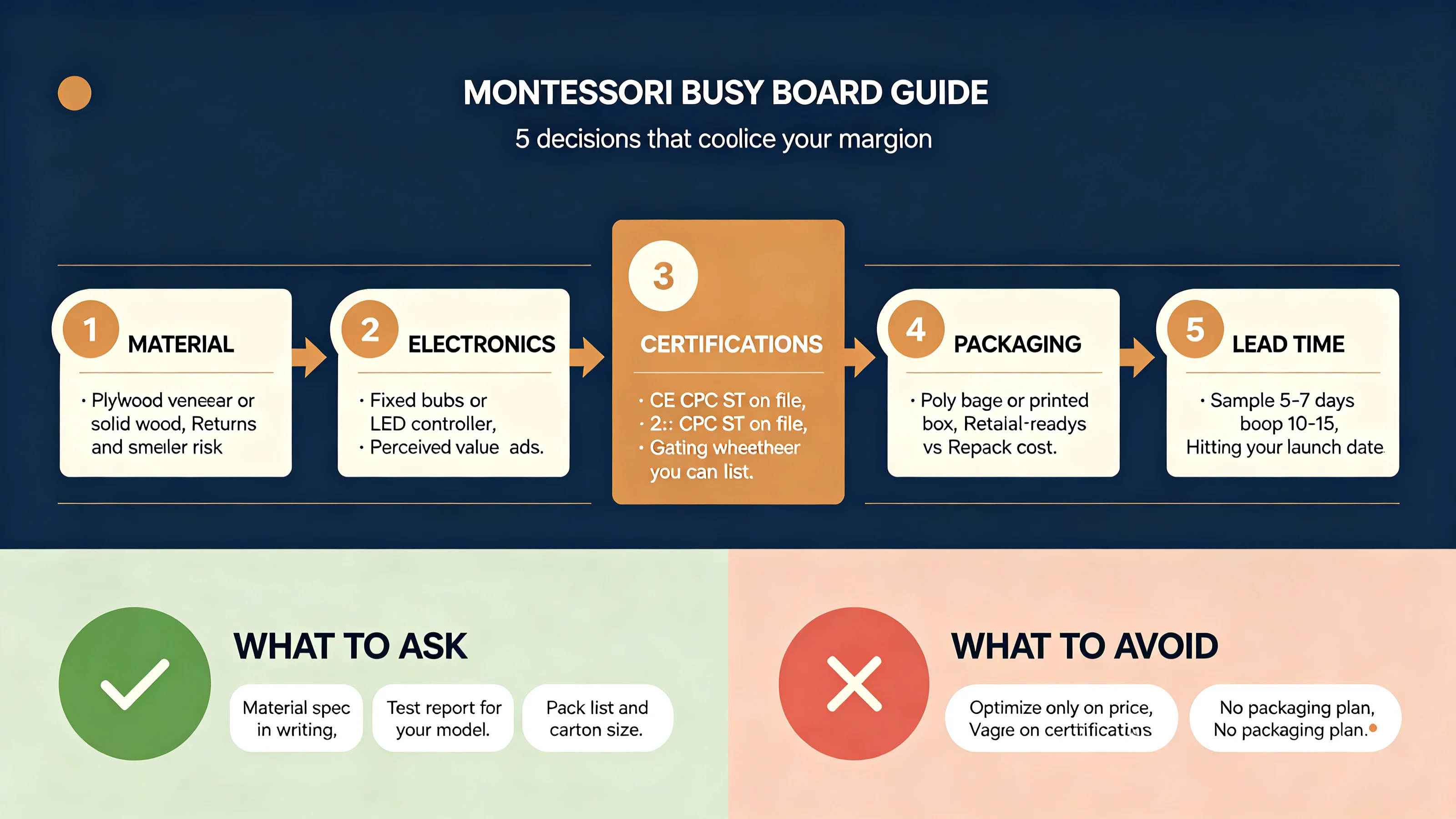
The short answer, for buyers who are already late for a meeting: a Montessori busy board sells because it does two jobs at once — it is a developmental toy parents feel good about buying, and it is a screen-free travel activity that keeps a toddler occupied in a car seat or on a plane. Five things decide whether you make money on it: the board material, the LED system, the safety certifications, the packaging, and the supplier's lead time. Get those five right and the rest is logistics.
This guide walks through all five, with the same numbers we use in our own factory in Wenzhou, China.
Quick reference for buyers
- MOQ: 100 pcs per model for OEM orders; 1–10 pcs sample orders always welcome
- Sample lead time: 3–7 days · Bulk lead time: 15–25 days
- Certifications: CE / CPC / ST test reports for current models
- Indicative FOB: USD 8–10 per unit at MOQ, depending on specification and quantity
- Shipping record: 1,221,200+ boards shipped, 15+ export countries, 98% on-time delivery
Why Montessori busy board wholesale keeps selling
Toddler toys are a brutal category. Most of them are bought once, break, and never come back. Busy boards behave differently for three structural reasons.
They solve a parent problem, not a child problem. Ask a buyer of a busy board what they actually wanted, and they rarely say "a toy." They say: something that keeps my 2-year-old busy on a 3-hour flight, or something that doesn't involve a screen. The product is sold against boredom and guilt, not against other toys — which means it does not compete on novelty the way a plastic gadget does.
They sit in a forgiving price band. At a retail price of USD 20–35, a wooden busy board is cheap enough to be an impulse gift and expensive enough to carry a real margin. It is the classic gift-with-meaning: relatives buy it for birthdays and Christmas, grandparents buy it without asking the parents, and it looks like it cost more than it did.
They photograph well. This matters more than most sourcing guides admit. A busy board with lit-up switches is a natural short-video product — the light response is instant, visible and satisfying, which is exactly what TikTok, Instagram Reels and Amazon video slots reward. A board that photographs badly cannot be advertised profitably, no matter how good the toy is.
That combination — real problem, forgiving price, good on camera — is why the category has stayed healthy while other toddler toys became a race to the bottom. It is also why a Montessori busy board wholesale programme is worth the sourcing effort: you are not buying a toy that has to be reinvented every season, you are buying a repeatable product with a stable cost base.
The five decisions that decide your margin
Before you compare quotes, decide what you are actually buying. Two boards can look identical in a photo and have completely different cost structures.
| Decision | Cheap option | Better option | What it does to your business |
|---|---|---|---|
| Board body | Plywood with veneer | Solid natural wood, sanded edges | Returns rate, smell complaints, shelf life |
| Electronics | 1–3 fixed lights | Multi-pattern LED board with master switch | Perceived value, ad performance, price band |
| Certifications | "We can test it if you pay" | CE / CPC / ST reports already on file | Whether you can legally list it at all |
| Packaging | Poly bag | Printed retail box, own barcode, master carton | Retail-ready vs. repack cost |
| Lead time | "About a month" | 3–7 day sample, 15–25 day bulk | Whether you hit your launch date |
Most first-time buyers optimize the first row and ignore rows three to five — then discover that the certifications gate their marketplace listing and the packaging eats their margin. On a Montessori busy board wholesale order, treat rows three to five as gates rather than preferences: no certificate, no listing; no packaging plan, no margin.
Solid wood vs plywood: the argument that protects your margin
On paper, plywood makes sense: it is cheaper, lighter, and every supplier in Zhejiang has it. In practice, plywood is bonded with adhesives, and that single fact creates most of the after-sales problems in this category — odour, off-gassing complaints, veneer chipping, and a board that looks tired after three months of toddler handling.
This is the point where a wholesale buyer's margin is actually won. A plywood board that generates a 4% return rate and an "it smells" review is not a cheap board; it is an expensive one. We covered this in detail in a separate piece on why the material choice matters more than the price tag, including what changed in the Japanese market in late 2025.
What to ask your supplier: what species, is it solid or veneered, and can they send the material specification in writing? A supplier who answers vaguely on this question will answer vaguely on everything.
The LED system: why 23 LEDs beat one light
The electronics are where a busy board stops being a wooden block and becomes a product people film. Three design details drive almost all of the perceived value:
- Number of switch types. Toddlers lose interest when every switch feels the same. A good board mixes toggle, rocker, push-button and rotary controls so that "what happens when I flip this one?" stays open.
- Light patterns, not just light. A single lamp per switch is a 30-second toy. A board that responds with varied colours and sequences is a 20-minute toy — and parents pay for minutes, not features.
- A master switch. Non-negotiable, and almost always an afterthought. Parents need a way to kill the lights instantly in a car at night without removing batteries.
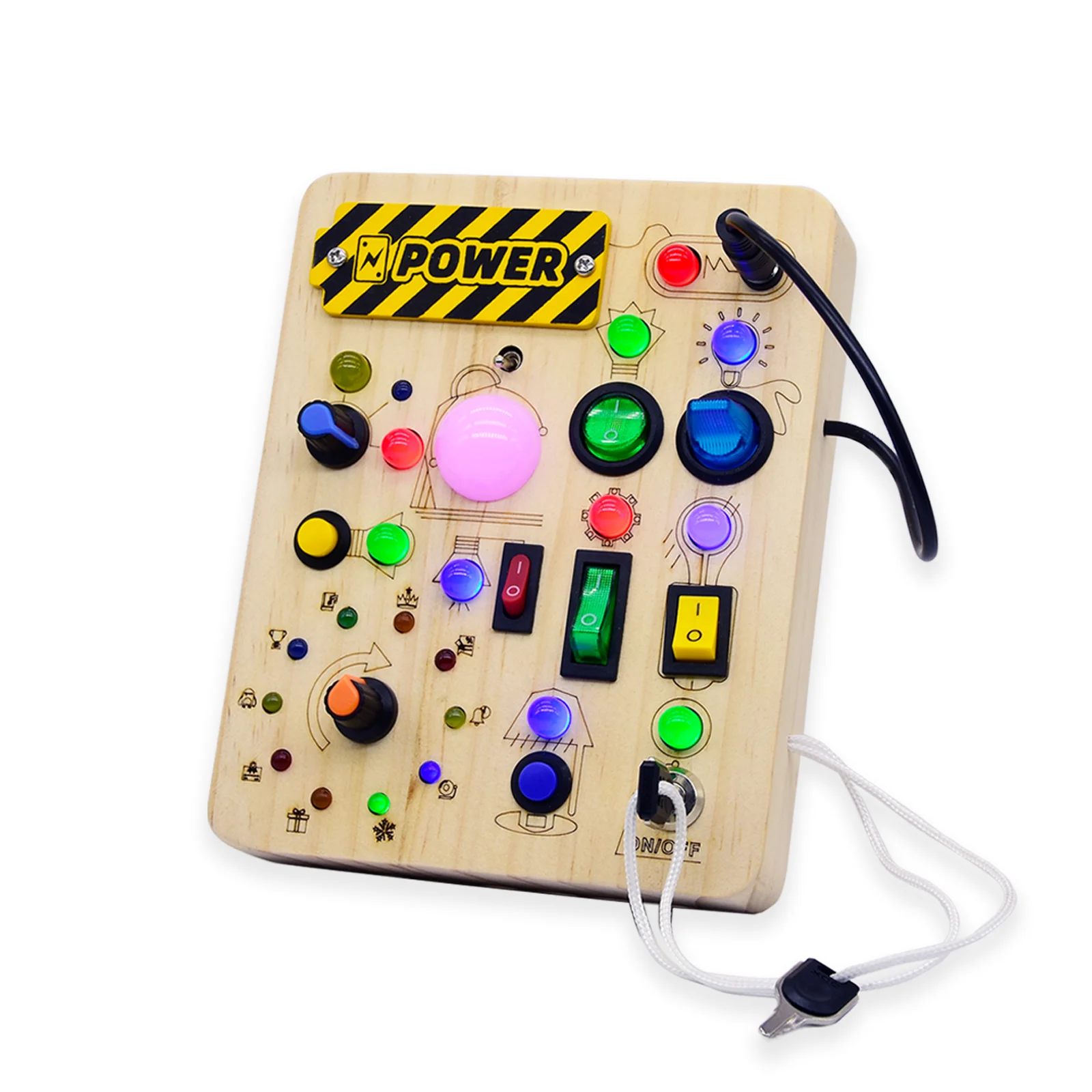
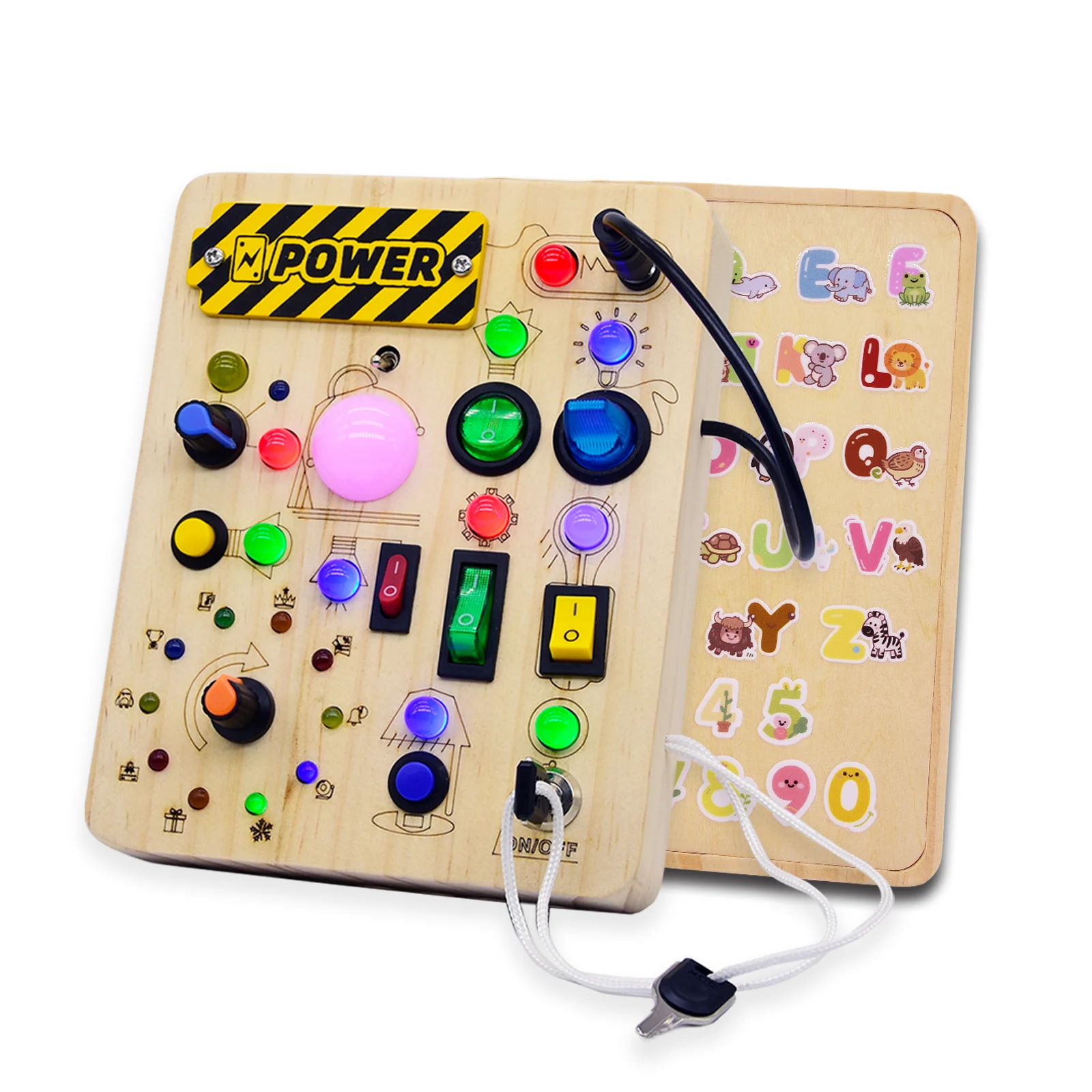
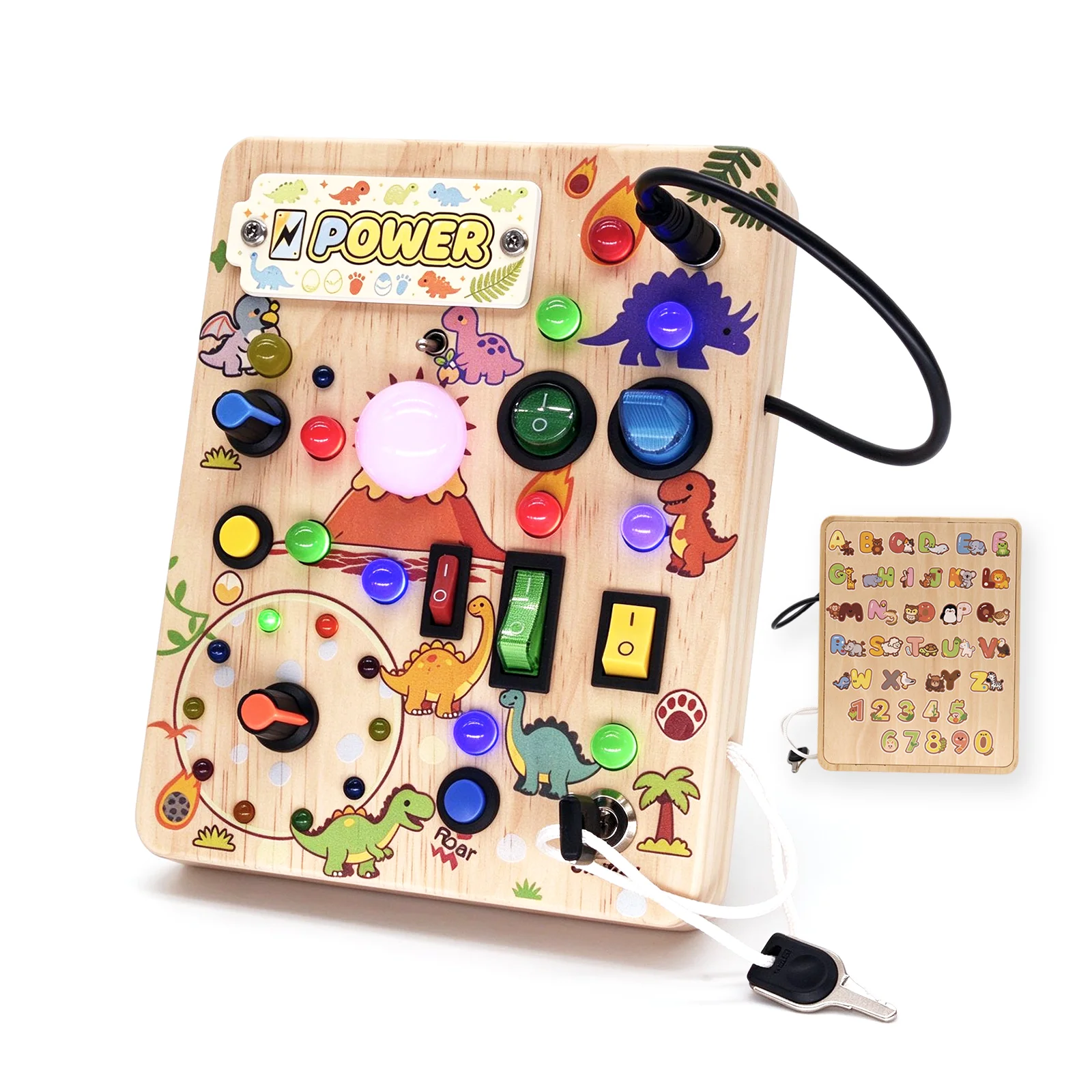
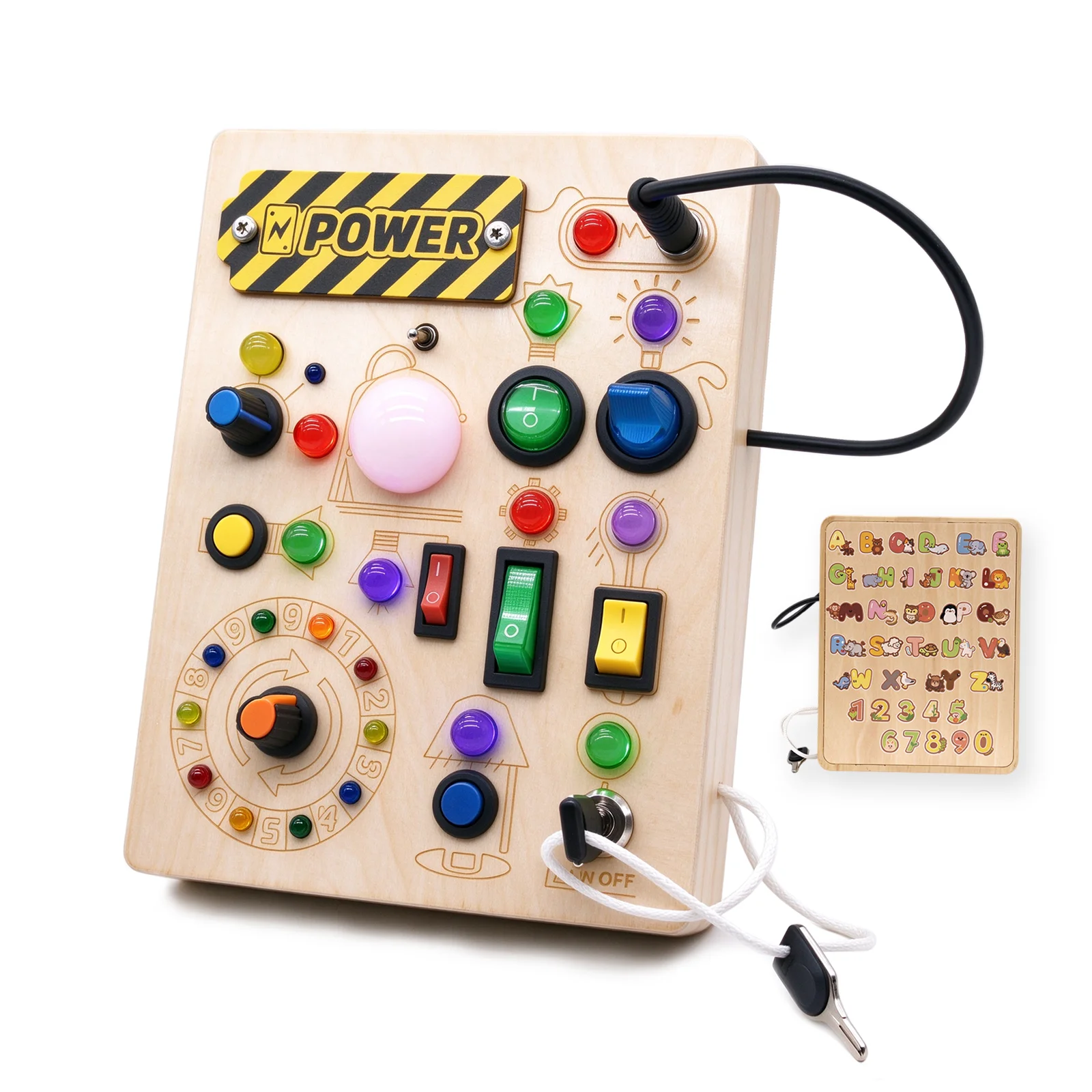
Our own three models are built around that logic, each with 12 switches driving 23 LED light patterns: a classic 12-switch LED board, an alphabet version with A–Z and 0–9 engraved on the back, and a dinosaur-front board for the theme-driven end of the market. All three run on 2 × AAA batteries (not included), which is deliberate: it keeps air freight and retail shelf compliance simple.
A note on batteries. Buyers regularly ask us to ship with batteries included. Refuse unless your market truly requires it — shipping cells internationally adds freight-class and compliance headaches that cost more than the batteries are worth, and most retail channels prefer the buyer to supply their own.
Certifications: what to ask for before you pay a deposit
This is the row that stops launches. Children's toys are among the most heavily regulated consumer products there are, and the documentation required differs by destination market.
- CE — required to place a toy on the EU/EEA market, tested against the toy safety standard and supported by a technical file.
- CPC — the Children's Product Certificate required for children's products sold in the United States, which must reference the applicable third-party test reports.
- ST — the Japanese toy safety mark, relevant if you are selling into Japan.
Our current models carry CE, CPC and ST test reports. But do not take any supplier's word for it — including ours. Ask for the report documents themselves, check the model numbers and the issue dates, and confirm the test house is one your destination market recognises. A certificate that references a discontinued model, or that is older than your market's current standard, is worth nothing when the customs paperwork is checked.
If you are unsure which documents apply to your market, tell us your destination country when you request a quote and we will tell you what we can supply — and, honestly, what you will need to arrange yourself.
MOQ, samples, pricing and lead time
Here is how our own funnel works, because it is representative of how a factory this size operates:
- Sample orders: 1–10 pcs, in 3–7 days. We offer a sample with a deposit that is deducted in full from your first bulk order — you pay only the shipping. Always test a physical sample before committing. Photos hide edge finishing, switch feel and light quality, and those three things are the entire product.
- Bulk MOQ: 100 pcs per model for OEM orders. Mixed-model containers are normal and we will build the carton plan around your mix.
- Bulk lead time: 15–25 days after artwork and deposit confirmation. Add transit: roughly 30–40 days by sea to most European and US ports, or 5–10 days by air express for urgent replenishment.
- Indicative FOB: USD 8–10 per unit at MOQ for our current LED range. Final pricing depends on board size, LED count, switch mix, packaging and print, so treat that as a starting band rather than a quote.
Where buyers get burned on lead time: art approval for printed packaging is usually the real bottleneck, not production. If you need goods on a shelf for a specific date, start the artwork before you start negotiating the unit price.
OEM and ODM: what you can actually change
Most of our wholesale clients start with one of our three existing models and change it. Typical customization for a 100–500 pc order:
- Front artwork — new theme or character, engraved or printed
- Back plate — blank, or engraved with letters, numbers, your logo, or a name
- Switch and LED configuration — within the limits of the mould and PCB
- Colourway — wood stain and light colour palette
- Packaging — retail box print, insert, manual, barcode and Amazon-ready labelling
- Law label — required for US retail, and something to raise early rather than at shipping time
If you want a fully new board shape, that is a development project with tooling cost and a longer timeline — tell us the concept and we will tell you honestly whether it is worth doing at your volume.
Quality control: the four checkpoints before your carton is sealed
Ask any supplier to walk you through their QC gates. A factory that cannot describe them in sequence does not have them.
- Incoming material — wood grade, moisture, thickness, and electronics batch check
- In-process — edge sanding and finish, then switch and LED function test on every board (not a spot check — every board gets switched on)
- Pre-packing — battery compartment, master switch, screw security, and light-pattern cycle
- Pre-shipment — carton drop test, quantity audit, and photo report sent to you before the container leaves
We send a photo report before shipment on every order, and our current record is 98% on-time delivery across 15+ export countries. Ask for the same from anyone you buy from.
Packaging and shipping
Two things quietly decide your landed cost:
- Retail-ready packaging. A printed box with your barcode and a law label turns a carton of boards into a sellable unit without a repacking step. Repacking at a 3PL costs more per unit than the box print does.
- Carton efficiency. Boards are small and flat; the win is in how many fit per carton and whether the carton dimensions fit a standard pallet without wasting cube. Ask for the carton dimensions and the units-per-carton before you approve the order, and do the pallet math yourself.
For a busy board at roughly 5.3 × 1.8 × 6.7 inches (13.5 × 4.6 × 17 cm) and about 0.93 lb (420 g), the difference between a well-planned and a lazy carton is often 15–20% of your ocean freight.
Frequently asked questions
What is the MOQ? 100 pcs per model for OEM orders — the standard starting volume for a first Montessori busy board wholesale order. Sample orders of 1–10 pcs are always welcome so you can evaluate quality before committing.
Do you provide free samples? Samples are supplied against a refundable deposit that is fully deducted from your first bulk order — you cover the shipping only.
What is the typical lead time? 3–7 days for samples, 15–25 days for bulk production after artwork and deposit confirmation, plus transit.
Which certifications do you hold? Our current models carry CE, CPC and ST test reports. We send the report documents with quotes so you can verify model numbers and issue dates.
Can you print our brand on the board and the box? Yes — OEM front artwork, back-plate engraving, colourway and full retail packaging print are all standard at MOQ. Send your artwork and target market and we will confirm feasibility.
Can you ship to Amazon FBA? Yes. We can label cartons and units to Amazon's requirements; tell us the fulfilment centre and the labelling specification at the order stage, not after production.
Next step
If you are evaluating this category, the fastest way to a real answer is a physical sample. Pick a model, tell us your destination market, and we will send both the sample and the certification documents — you will know more in a week than in a month of comparing quotes.
- Browse the full range: LED busy board models
- Request a quote or a sample: contact us
- Read next: why material choice decides your returns rate and how Montessori-inspired play builds focus in early childhood
Related reading
- MOQ, pricing and lead times — what to expect on a first order
- 12-point supplier checklist — how to vet a factory before you pay a deposit
- what actually drives your cost per unit — line-item cost breakdown
If this raised a specific question, Montessori Busy Board Wholesale: A Retailer's Buying Guide goes deeper, and Essential vs Classic: Which Busy Board Fits Your Market? (Affordable Busy Board Wholesale, 2026) covers the part most buyers ask about next.