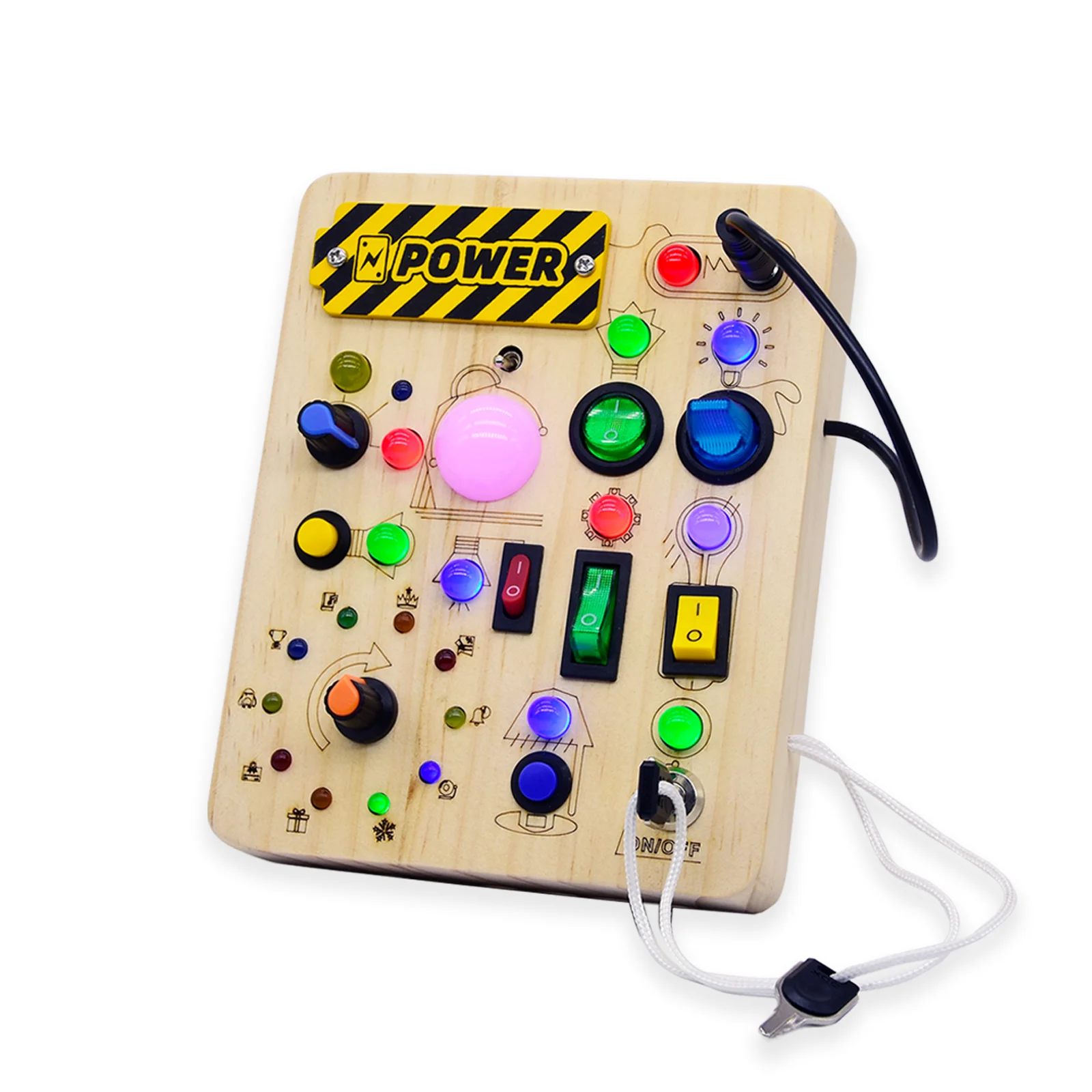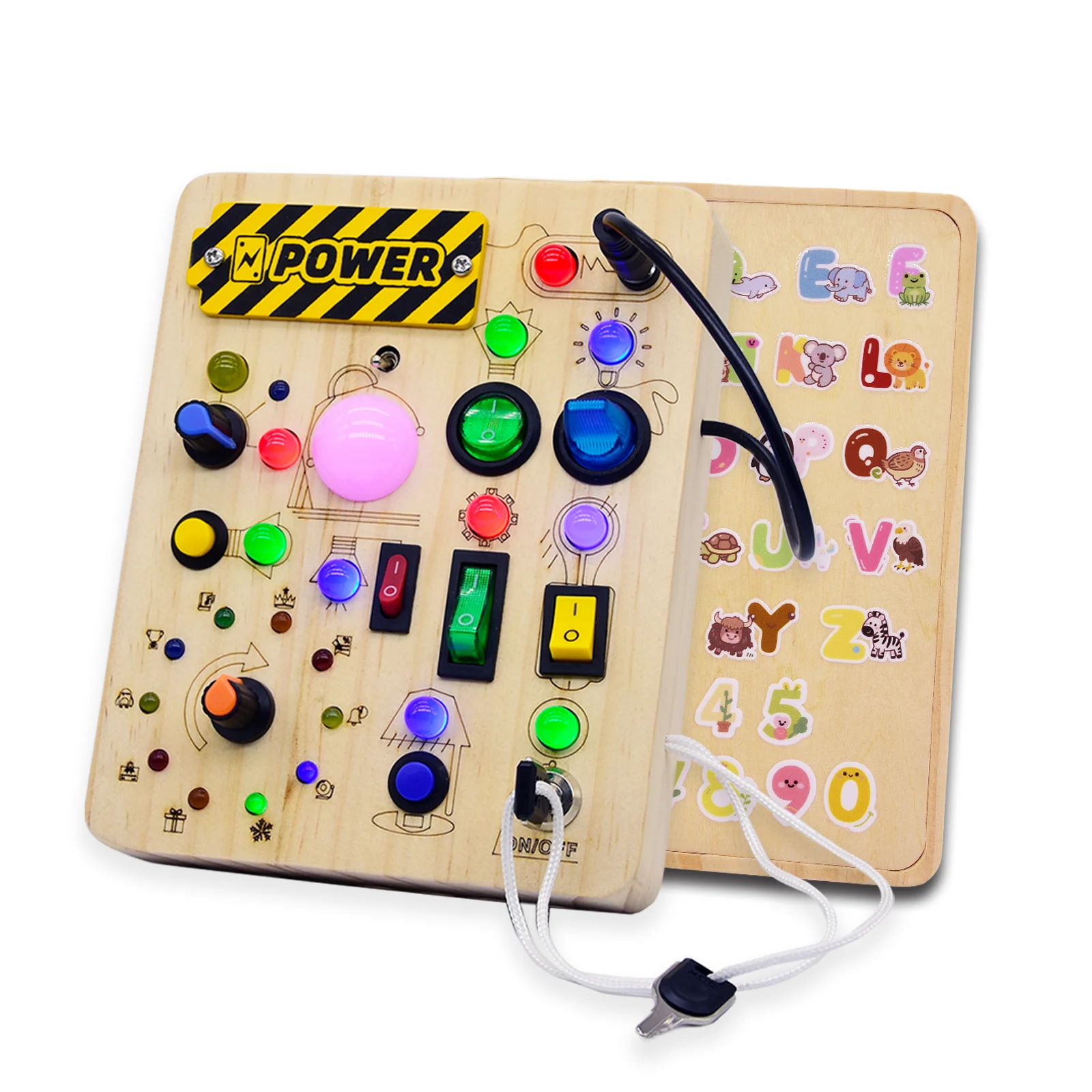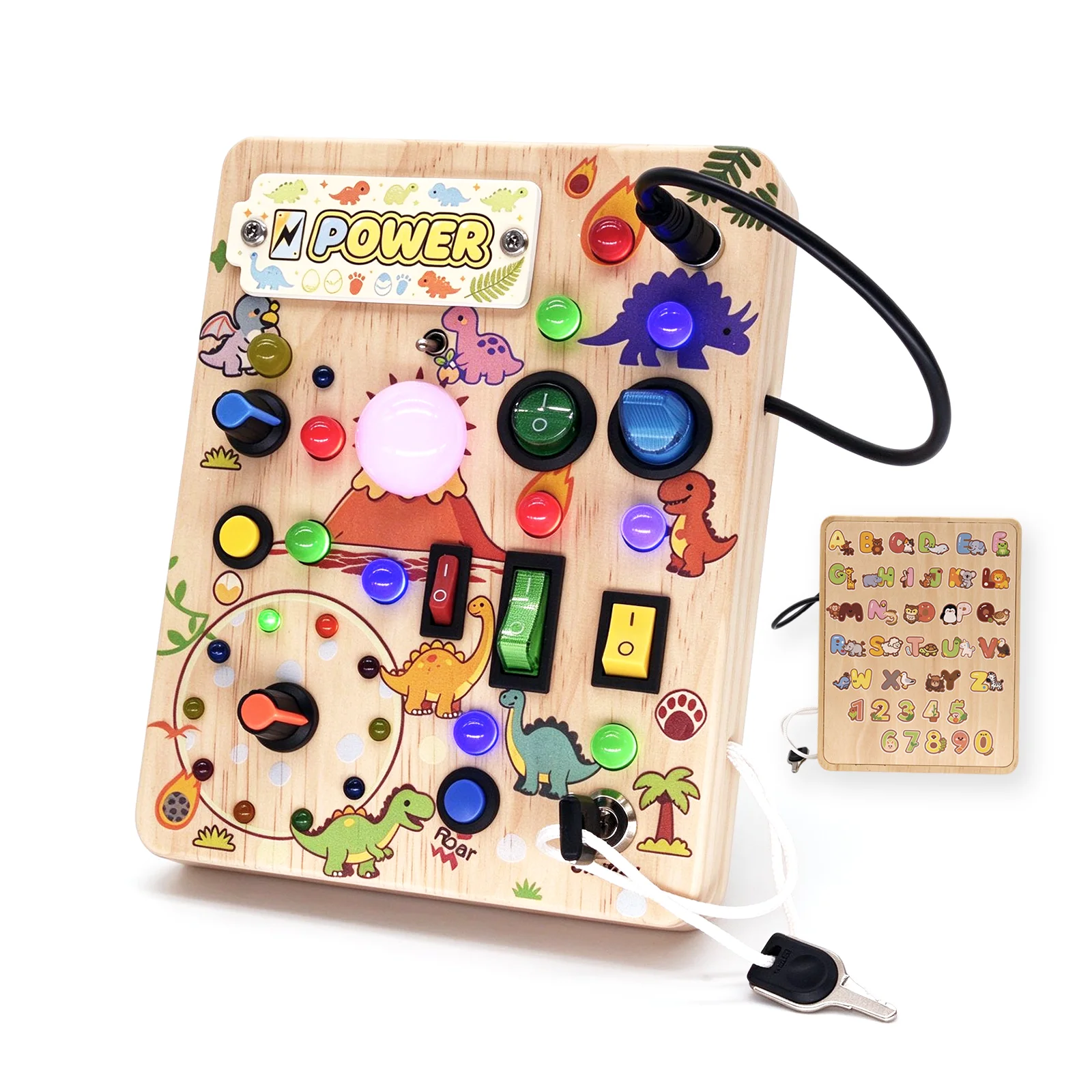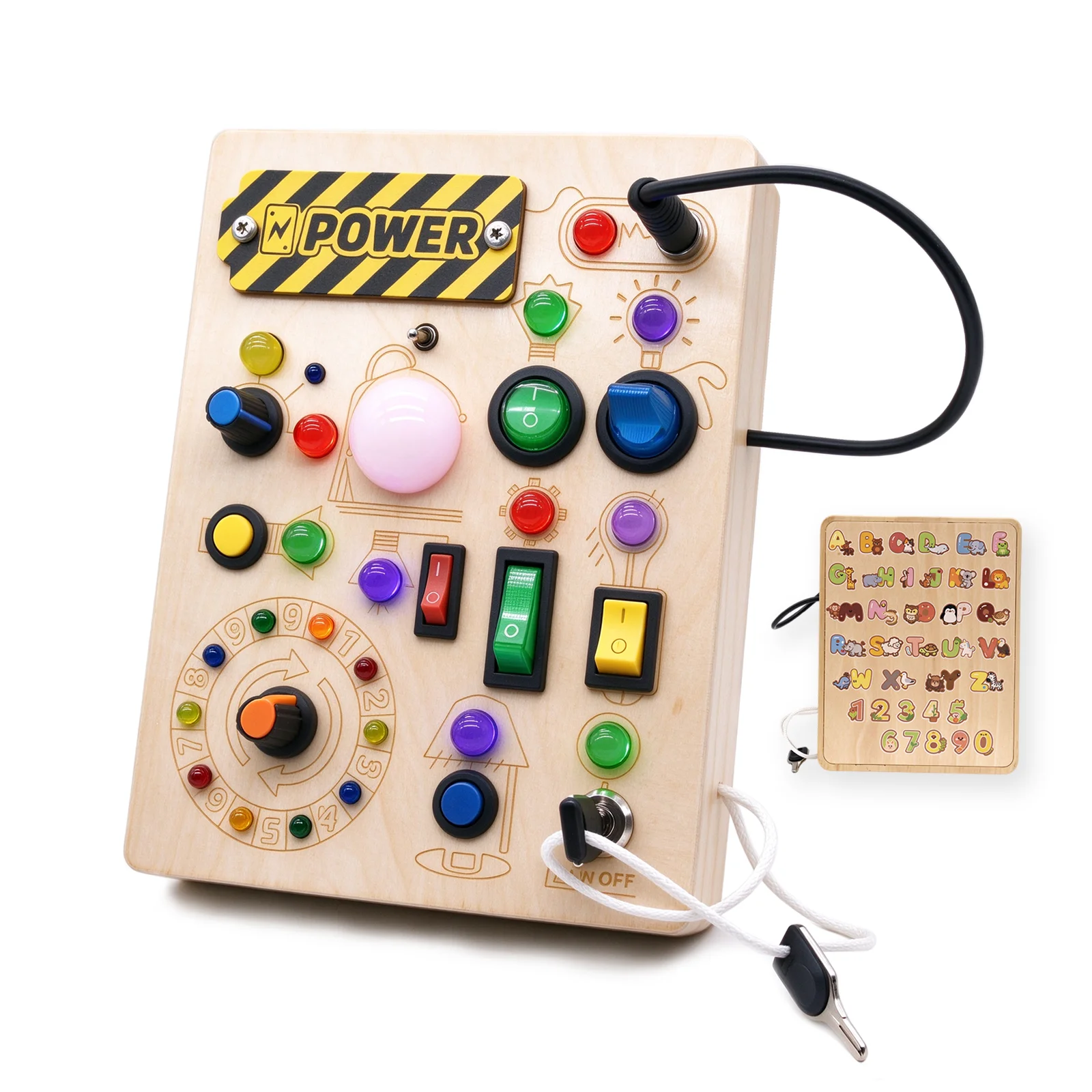
Short answer: when you're buying an LED busy board wholesale, the price is the last thing you should look at, and it's the first thing most buyers do. Two boards that photograph identically can differ by the controller inside them, the battery box on the back, and whether anyone has tested the electronics at all. Only one of those boards survives its first returns season. What follows is how we would spec an LED board if we were sitting on your side of the table. We're the factory in Wenzhou, so read it knowing we make money when you buy the parts that last.
A busy board with lights is a small electronic device wrapped in wood. Most buyers treat it as a wooden toy that happens to glow, and that assumption is where orders go wrong. The electricity is the part with failure modes, certification exposure, battery rules and after-sales cost. The wood, the switches and the paint behave the way wood always has.
So this guide stays on the electronics: the specs worth pinning down before you order, and the risks that decide whether the premium you pay for lights is an asset or a write-off.
Quick facts
- MOQ: 100 pcs per model · 200 pcs for custom artwork or engraving · 500–1,000 pcs for full OEM
- Samples: 1–10 pcs, 3–7 days, credited back against the bulk order
- Lead time: 15–25 days after deposit and artwork approval
- Platform: 12 mixed switches · 23 lighting modes · 2 × AAA batteries (not included)
- FOB at MOQ: $8.90 Classic · $9.20 Alphabet · $9.50 Dino · recommended retail $20–35
- Certifications: CE / CPC / ST reports on current models, tested to EN 71 and ASTM F963
Buying an LED busy board wholesale: start with the light system
There are two ways a board can light up, and in a listing photo they look the same.
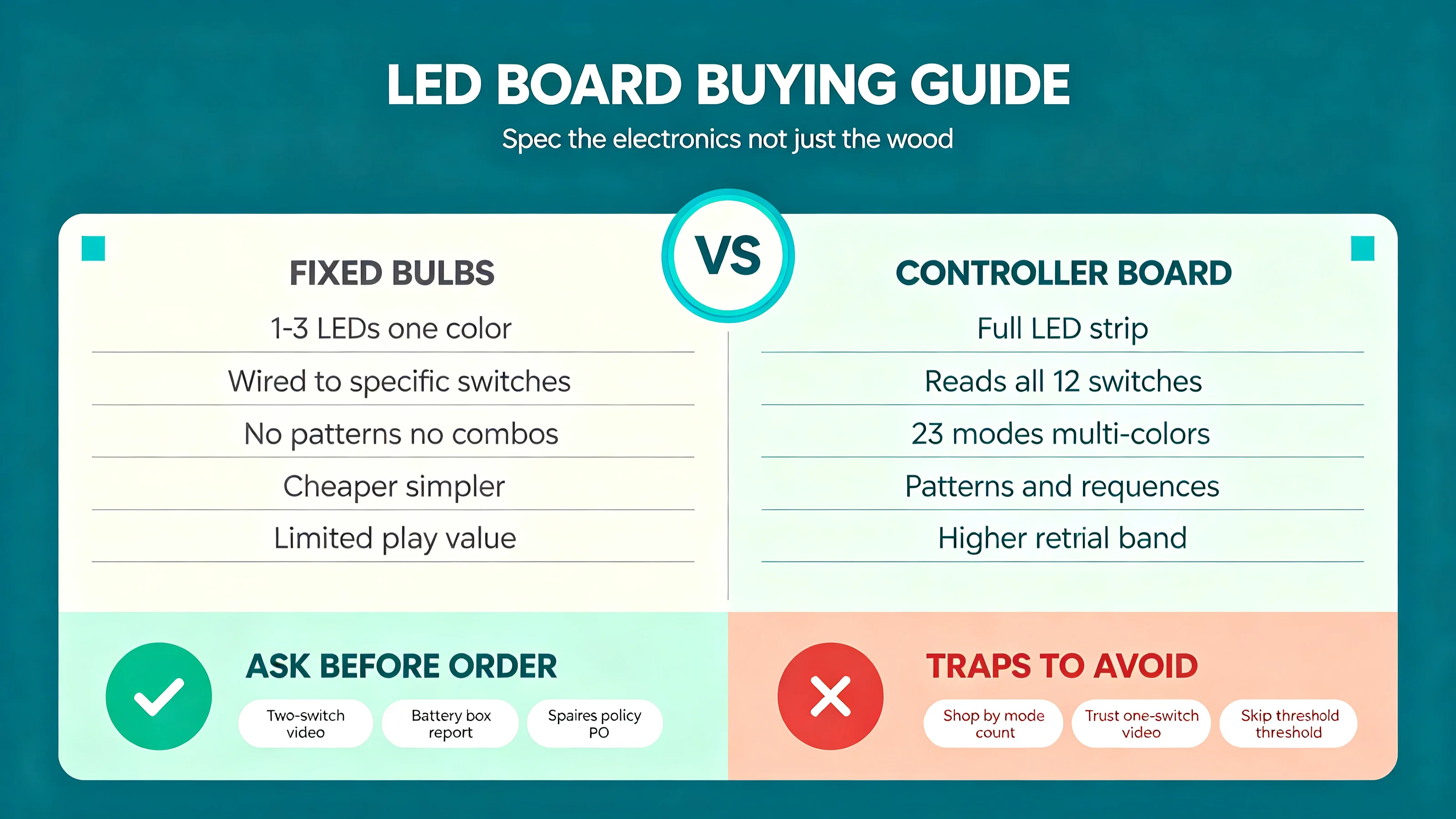
A fixed-bulb board wires one to three LEDs straight to specific switches. Flip the wired switch and the bulb comes on; flip any of the others and nothing happens, because nothing is connected to them. It is cheap, it rarely fails, and it teaches a child exactly one idea: this switch makes a light.
A controller board reads which switches have been toggled and drives the LEDs in response. Light can appear in more than one colour, react to the combination, and run short patterns. This is the board a parent describes as "the one that actually does something."
You can find out which one a supplier is quoting with a single question: ask how the light responds to the switch. If the answer is "every switch has its own light," you are being quoted a fixed-bulb board no matter what the listing claims. If the answer describes colours or patterns reacting to what the child toggles, you are looking at a controller. Then close the last gap with two follow-ups:
- Does every switch on the front do something to the light, or only some of them?
- Can you send a short video of two switches working at the same time?
That video request matters more than it sounds. A fixed-bulb board can be filmed one switch at a time and still look busy. Two switches at once will expose a board where only the wired ones respond. This one exchange, plus the video, settles most of the sourcing risk in LED busy board wholesale before a price is ever mentioned.
We compared the two systems in LED vs traditional busy boards. This piece assumes you've settled on the light version and are now deciding how to buy it.
More lighting modes is not automatically better
Our platform runs 23 modes. The number is real and we put it on the spec sheet, but we tell buyers not to shop by it.
Mode count is a bill-of-materials line, not a play-value line. Going from around ten modes to twenty-three adds controller capacity and firmware work, and it shows up in the unit cost. What it does not do is add proportional play time. In our own testing a child reaches for a handful of patterns and ignores the rest, and somewhere past a dozen visible modes you are paying for options nobody selects.
The modes that count are the ones a small child can actually reach. Ask how a child gets from mode one to mode five. If the honest answer is "press the mode button four times," most two-year-olds never leave the first pattern, and your 23-mode board becomes a two-mode board in practice. What works is a short cycle of a few clearly different behaviours, or a control simple enough that a child stumbles onto it.
There is a quieter risk in a long mode list, too. More firmware states means more ways for the board to freeze or reset. A 23-mode controller that hangs every so often is worse than a six-mode controller that never does. When a sample arrives, cycle through the modes and watch for a board that gets stuck, not just one that flashes.
The switch mix decides what the lights can do
On a light board the switches are not decoration. They are inputs, and what the child can press determines what the lights can express. Twelve identical toggles hand the controller twelve identical signals. A toggle, a rocker, a push button and a rotary dial hand it four kinds of input, which is what lets the light respond in four different ways.
This is the spec buyers most often leave blank. When a quote says "12 switches," it says nothing about how many feed the light logic and how many are purely mechanical. Ask which switches are wired to the controller and what each one does. A rotary dial that changes brightness, a push button that steps the mode, a rocker that reverses a pattern: those are the inputs a child notices. A row of eight toggles driving one colour is not the same board.
The mix also moves your cost in both directions. Blending switch types raises assembly time compared with stamping out one type ten times over, and that is a real line on the BOM. We set out how switch count and mix feed into unit price in our wholesale price guide, if you want the numbers beside this.
Battery box safety is the spec that gets a product recalled
The battery compartment is where an otherwise good toy ends up on a recall notice. Small cells are an ingestion hazard, and a box a toddler can open is the failure that gets you there.
Two things have to be true. The cells must not be reachable by a child, and the box must stay shut through the abuse a toy actually receives. In practice that means either a screw-secured cover, with a recessed screw rather than a thumb catch, or a cover that needs two independent movements to open. A cover that slides is not enough. Children open slides.
What EN 71 and ASTM F963 actually require here
Both standards treat a battery-operated toy as a mechanical toy with an extra requirement attached. The compartment has to be child-resistant under the applicable clauses, and the toy still has to pass the standard drop and tip tests with the compartment shut. Under EN 71-1 the mechanical and physical tests include torque and tension sequences aimed at small parts a child could work loose. Under ASTM F963, the requirements for battery-operated toys sit in the electrical and thermal section alongside the mechanical abuse tests. Our models carry current CE / CPC / ST reports against these standards; the fuller map of what each mark covers is in our busy board safety certifications guide.
For you as a buyer, this means one habit: request the report for the exact model, and check that it covers the battery compartment, not just "wooden toy, mechanical." A report for a different model, or one dated three years ago, tells you nothing about the batch in front of you.
The test we run before a batch ships
After assembly we drop the board, then try to open the battery box the way a determined three-year-old would: push, pry, twist, shake. If a screw or a latch gives, it does not ship. It is not a laboratory protocol, and we would never claim it replaces the standards, but it catches the failures that actually reach customers.
Why we don't ship batteries
Every board we make takes 2 × AAA cells, and every board leaves the factory without them. Buyers ask about this constantly, usually because they assume we are saving a few cents. It is the opposite.
Put cells in the box and you change what you are shipping. Depending on the carrier and the destination, cells packed with a toy can move the consignment into a battery-handling category that wants safety data sheets, a test summary for the cell, and specific packaging. That paperwork and handling cost more than the batteries ever will, and it lands on whoever is the importer of record, which is you. Ship without them and the board stays a wooden toy with a plastic cage in it. We cover the packing and freight side of that in our packaging and shipping guide.
Two more reasons, both in the buyer's favour. Cells have a shelf life, and a pallet that sits in a warehouse for eight months can reach the shelf with a compartment full of weak or leaking cells, a complaint the retailer fields, not the factory. And most buyers we work with would rather attach their own branded cells at the store, or sell them as a small add-on. Shipping empty leaves that decision where it belongs.
The electronics risk that shows up after the container lands
Here is the part of the LED premium that buyers forget to price in: electronic parts fail, and they tend to fail after the goods leave the factory dock.
The failure modes we see on returns
The list is short and consistent. An LED, or a segment of the light strip, dies. A switch stops registering, so a light that used to come on no longer does. A solder joint on the controller board cracks in transit and the board arrives dead or flickering. A battery spring loses tension and the toy only works if you hold the cell in place. And every so often a controller ships with firmware that locks up, which is the hardest one to catch in sampling and the most irritating at retail.
None of these is exotic. They are the ordinary wear profile of a cheap electronic device inside a child's toy, and the fix at your end runs from "change the batteries" to "refund the customer and eat the shipping."
What to ask for in the PO
Get the spares policy in writing before you order, and put it in the purchase order rather than a chat thread. At minimum:
- A stated defect threshold: at what percentage does the factory replace instead of you absorbing it?
- A small percentage of spare units or spare parts in the shipment, so one dead board does not become a full refund.
- Spare-part SKUs you can reorder later: spare switches, spare controller boards, spare battery springs.
- The warranty window, and what "warranty" means in practice: credit, replacement units, or parts only.
- Who pays freight on a defect claim.
A supplier who cannot answer these is either too small to have thought about it or hoping you won't ask. Both are worth knowing before you wire a deposit. If you're comparing several factories on this alone, our guide to choosing a busy board supplier turns it into a checklist.
What LED busy board wholesale should cost, and the premium it supports
Now the money. Every LED busy board wholesale order we quote runs on the same controller and switch platform, and the three catalogue models sit close together: $8.90, $9.20 and $9.50 FOB at 100 pieces. The differences are artwork and back panel, not the electronics.
The LED system itself is roughly $1.50–2.00 per unit against a fixed-bulb board, and it is the largest single block in the electronics cost. Here is how the three light systems line up for a buyer:
| Light system | Modes | Cost vs fixed bulbs | What the child experiences |
|---|---|---|---|
| Fixed bulbs | 1–3, one colour | reference point | A switch makes a light; no combinations |
| Basic controller | ~6–10 | +$1.00–1.30 | Colours respond; a few repeatable patterns |
| Full controller (our platform) | 23 | +$1.50–2.00 | Colour, sequences and patterns across 12 mixed switches |
Where does that premium land at retail? A plain wooden board at this build quality typically sells for about $15–22. A well-made light version sits at $20–35 depending on model and channel. So the premium you pay at the factory, a dollar or two, is meant to support a retail gap several times larger, because the light version is the SKU that gets picked off a shelf beside a plain one.
That is the argument for paying for a real controller. It is no argument for paying for 40 modes. The premium is earned by a board that lights up in a way a child can see and repeat, not by a longer spec list.
| Model | FOB at MOQ 100 | Switches | Recommended retail |
|---|---|---|---|
| Classic | $8.90 | 12 mixed | $20–25 |
| Alphabet | $9.20 | 12 mixed | $22–28 |
| Dino | $9.50 | 12 mixed | $25–35 |
Questions buyers ask us every week
Is the LED version worth more than a plain wooden board? For most retail channels, yes, up to a point. A light board holds attention longer than a plain one, which tends to show up as fewer returns and better reviews. Past roughly a $2-per-unit electronics premium, though, you are buying specification rather than play.
How many lighting modes should I ask for? Enough that a child can reach different behaviours easily, and no more. In our experience that is somewhere between six and a dozen clearly distinct visible modes. You can ask for 23; just test whether a small child can get past mode two.
Can you insert our batteries and ship the board ready to play? We don't ship with cells, for the reasons above. If ready-to-play is essential to your channel, talk to us about how the battery paperwork would be handled, because as importer that obligation sits on you, not us.
What happens if some units are dead on arrival on an LED busy board wholesale order? Better to define that before you order than to argue about it afterward. Ask any factory for a defect threshold in writing. Ours sits in the PO, with spares and replacements handled under the policy above.
Do you supply spare parts? Yes: spare switches, controller boards and battery springs, as reorder SKUs. For a buyer running a repair or returns desk, a bag of spare parts is far cheaper than a drawer full of refunds.
Why is your LED board more than the $4 ones I see online? Because those are usually fixed-bulb boards dressed up with a photo of a controller board. Ask how the light responds to the switch, and which model the certification report covers. The answers usually close the gap on their own.
What we'd do in your position
If you're placing your first LED busy board wholesale order, don't lead with the price. Ask the light question, request the two-switch video, pull the certification PDF for the exact model, and read the spares policy before you talk numbers. Two of those four will eliminate most of the field.
For a first order, take 100 pieces of the model that suits your shelf and packaging, and insist on a real controller rather than fixed bulbs. Test it on the floor, hand it to a child if you can, and cycle every mode, because a sample that freezes once will freeze more in a thousand units. The dollar or two you spend on a tested board is cheaper than the first return.
If you already sell a light board and your returns are creeping up, the cause is usually one of three things: a battery box a child can open, a switch that stops registering, or a controller with no spare-parts path. Fix whichever one shows in your data, and negotiate the spares policy before your next order rather than after.
And if you just want the numbers, send us your target quantity, port and packaging. We'll quote the LED platform with the electronics line broken out, so you can see exactly what the controller costs you and judge whether the premium earns its place on your shelf.
Two more angles on this: LED Busy Board vs Traditional Busy Board: Which Sells Better for Retailers covers the sourcing end, Light-Up Busy Board with Buttons and Lights: A Wholesale Buyer's Guide (2026) covers what buyers ask about first, and Dinosaur Busy Board Wholesale: A 2026 Sourcing Guide for Retail Buyers is the one we send when someone asks for the whole picture.