Short answer: a light up busy board sells better than a plain one not because it's a "new toy," but because it films itself and demos itself on the shelf. The risk is the electronics: the same photo can hide either an LED board with a full set of lighting modes or three cheap bulbs wired straight to a switch. Here's how to tell them apart, what drives the price, and what to ask about safety. Every figure is what we use at our own factory in Wenzhou, China.
Quick facts for wholesale buyers
- MOQ: 100 pcs per model for the catalogue · 200 pcs for your own artwork or engraving · 500–1000 pcs for full OEM
- Samples: 1–10 pcs in 3–7 days, cost credited against the bulk order
- Production lead time: 15–25 days after deposit and artwork approval
- Certifications: CE / CPC / ST test reports ready (based on EN 71 / ASTM F963)
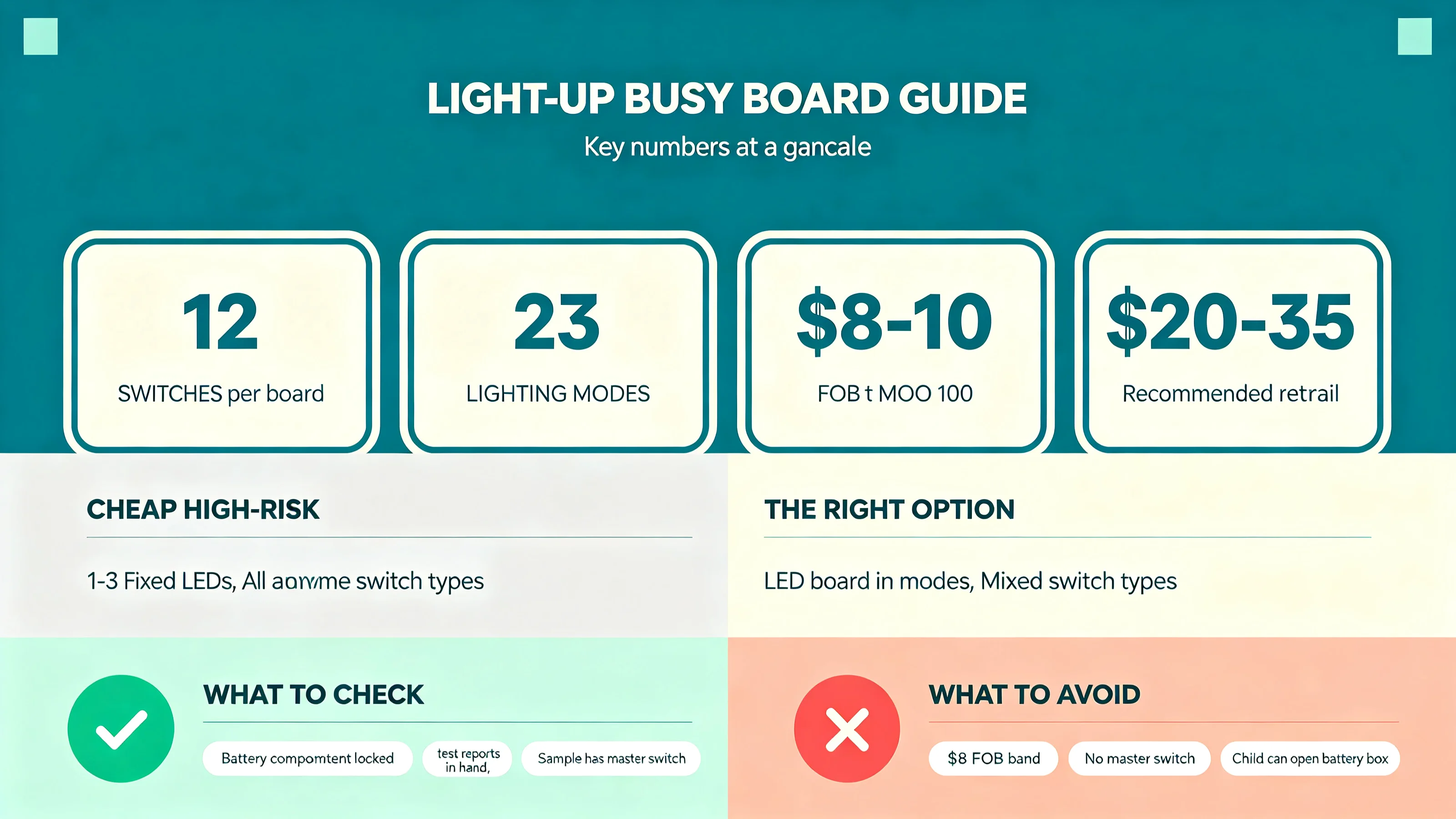
- Indicative FOB price: 8–10 USD per unit at MOQ
- Track record: 1,221,200 boards shipped, exports to 15+ countries, 98% on-time delivery
Light up busy board wholesale: why it sells well
Most kids' toys are bought once; a busy board is repeatable, and the light-up version has three advantages. It lands in a comfortable price band: at a recommended retail price of 20–35 USD it is cheap enough to be an impulse gift and expensive enough to carry real margin. It solves two problems at once — parents aren't buying a toy but screen-free time, something to occupy a two-year-old in a car or a queue — and light holds attention longer, so it is returned less often as "bored." And it looks good on camera: the light reacts instantly, which is what short videos reward, and a product that films badly can't be advertised at a profit.
What sets a light-up busy board apart: LED board vs separate bulbs
The real fork is the electronics, not the wood. "Light-up" can mean two very different systems. The cheap version is one to three fixed LEDs hard-wired to specific switches — always one colour, no logic, dead after 30 seconds. This is the item behind reviews that say "we sell the same thing three times cheaper." The right version is an led busy board that reads the position of the switches and produces different colours and sequences — a set of modes — so a child keeps asking "what happens if I flip this one?" Parents pay for minutes of play, so a mode set raises perceived value. That is the 8–10 USD versus "dirt cheap," and it decides whether your retail price holds at 20–35 USD.
| Decision point | Cheap (high-risk) option | The right option | What it changes for you |
|---|---|---|---|
| Light | 1–3 fixed LEDs | LED board with a set of modes and sequences | Perceived value, advertising, in-store retention |
| Switches | All of one type | A mix of toggles, rockers, push buttons, rotary dials | Minutes of play, reviews |
| Master switch | None — "just take the batteries out" | A dedicated master switch for all the lighting | Returns, complaints, parent convenience |
| Battery compartment | Opens by a child's hands | Screws or a lock, cells unreachable by a child | Passing toy-safety requirements |
| Certifications | "We'll check if you pay" | CE / CPC / ST reports for current models | Whether you can list the product at all |
| Body | Plywood with a veneer | Solid wood, sanded rounded edges | Smell, returns, service life |
Most buyers optimise the light and ignore the rest — then the battery compartment blocks the listing and the missing master switch brings one-star reviews.
Switches: why you have to mix them
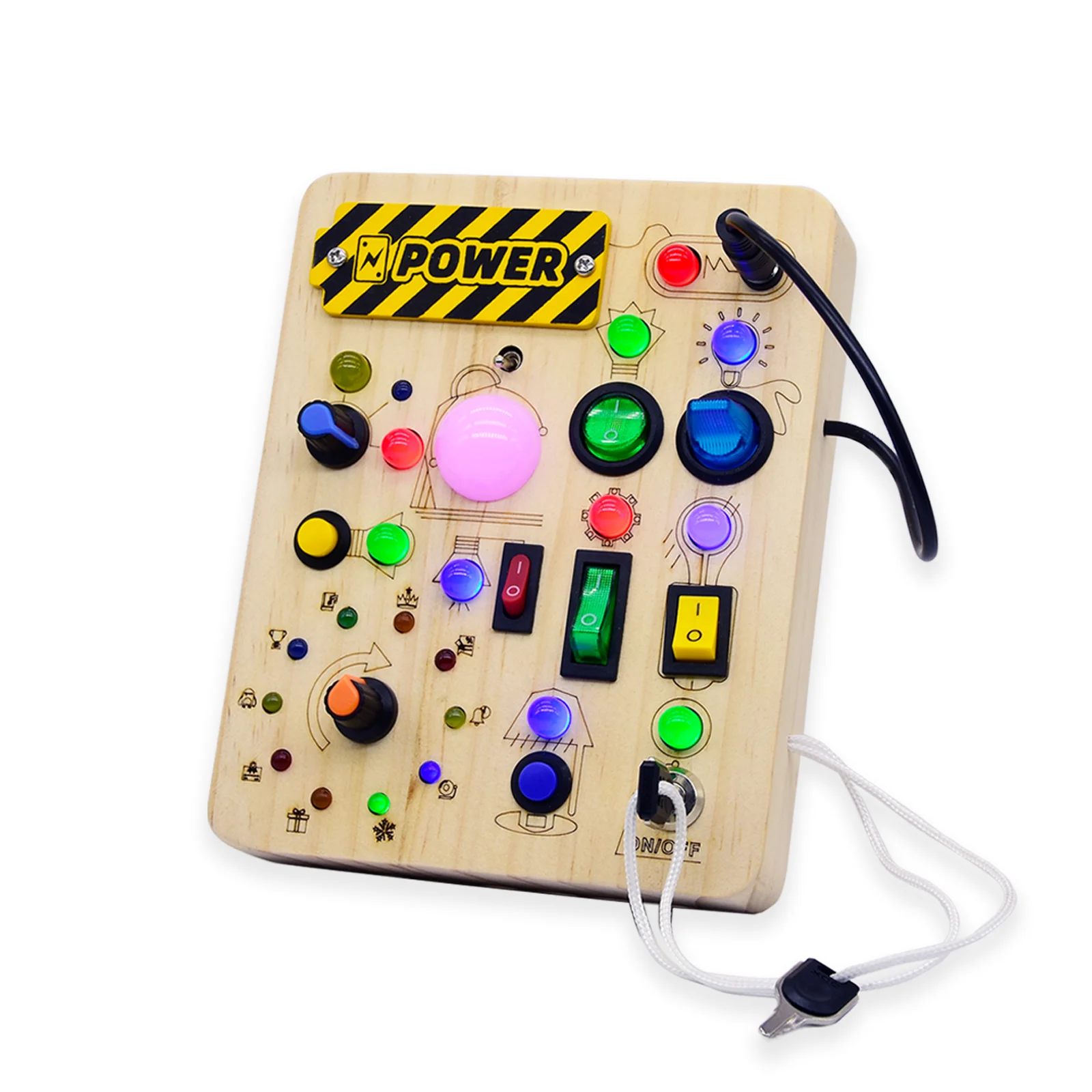
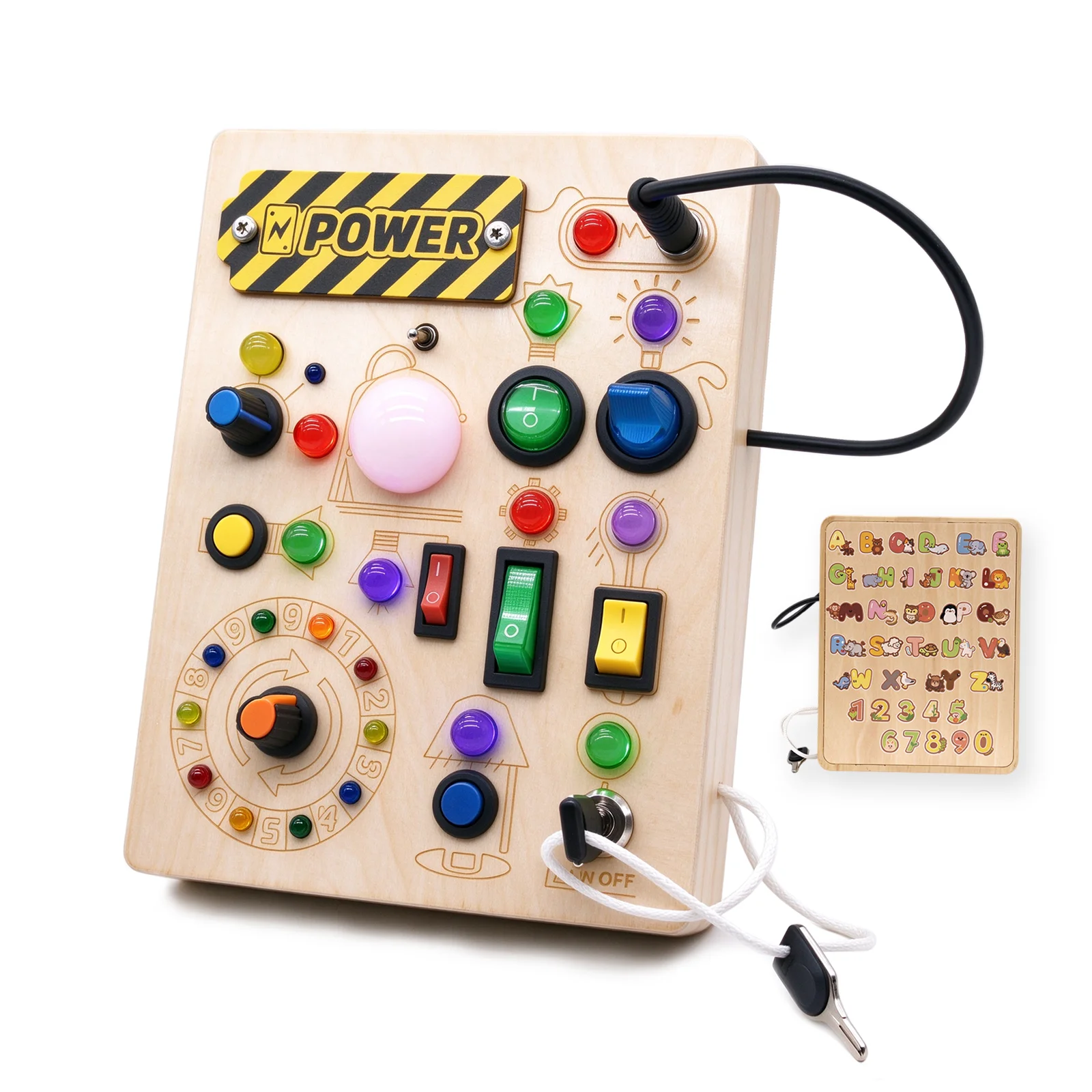
An led busy board lives or dies on its switches, and the reward comes from four types: toggles (instant reaction, the favourite under three), rocker switches (the household "click," reinforcing everyday logic), push buttons (tactile feedback and the simplest path to light), and rotary dials (fine motor skills and a longer "turn it, then it flickers" chain). A child loses interest when every switch is the same; a mixed set keeps the question open, and that openness is what parents pay for. Our models run on one platform: 12 switches and 23 lighting modes, powered by 2 AAA batteries (not included). We omit batteries on purpose — shipping cells adds a dangerous-goods class and paperwork that costs more than the batteries themselves.
The master switch: a small part that saves your reviews
A master switch is essential and almost always missing from cheap batches: parents need to kill the light in a car at night without pulling the batteries. Check it by hand at the sample stage, and confirm it kills the whole lighting at once, not just individual bulbs.
Battery compartment, safety, and CE / CPC / ST
Electronics add one requirement — battery safety. A board with buttons and lights must still meet EN 71 for the EU and ASTM F963 for the US, and the battery compartment must follow the rules for battery-operated toys: the compartment must be unreachable by a small child, closed with screws or a lock. This is exactly where a cheap supplier saves money, so if an LED board is quoted well below the market range, ask how the compartment is secured and how much testing is behind the certification. CE is required to place a toy on the EU/EEA market, the CPC is the children's certificate for the US market, and the ST mark applies to Japan. Our current models have ready CE, CPC and ST reports — but don't take any supplier's word, including ours: request the documents themselves, check the model numbers and dates, and confirm the lab is recognised in your market.
Three models and indicative FOB prices
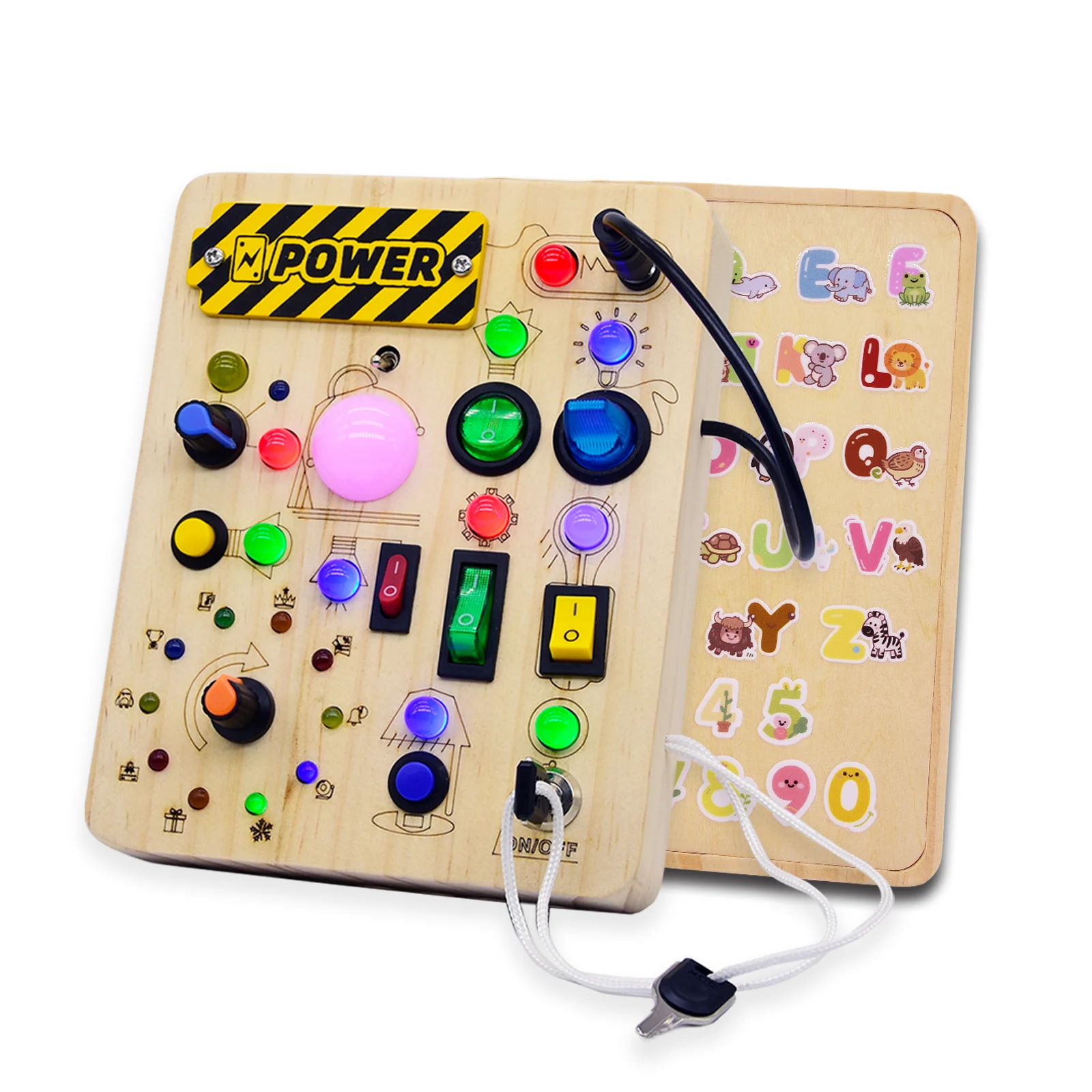
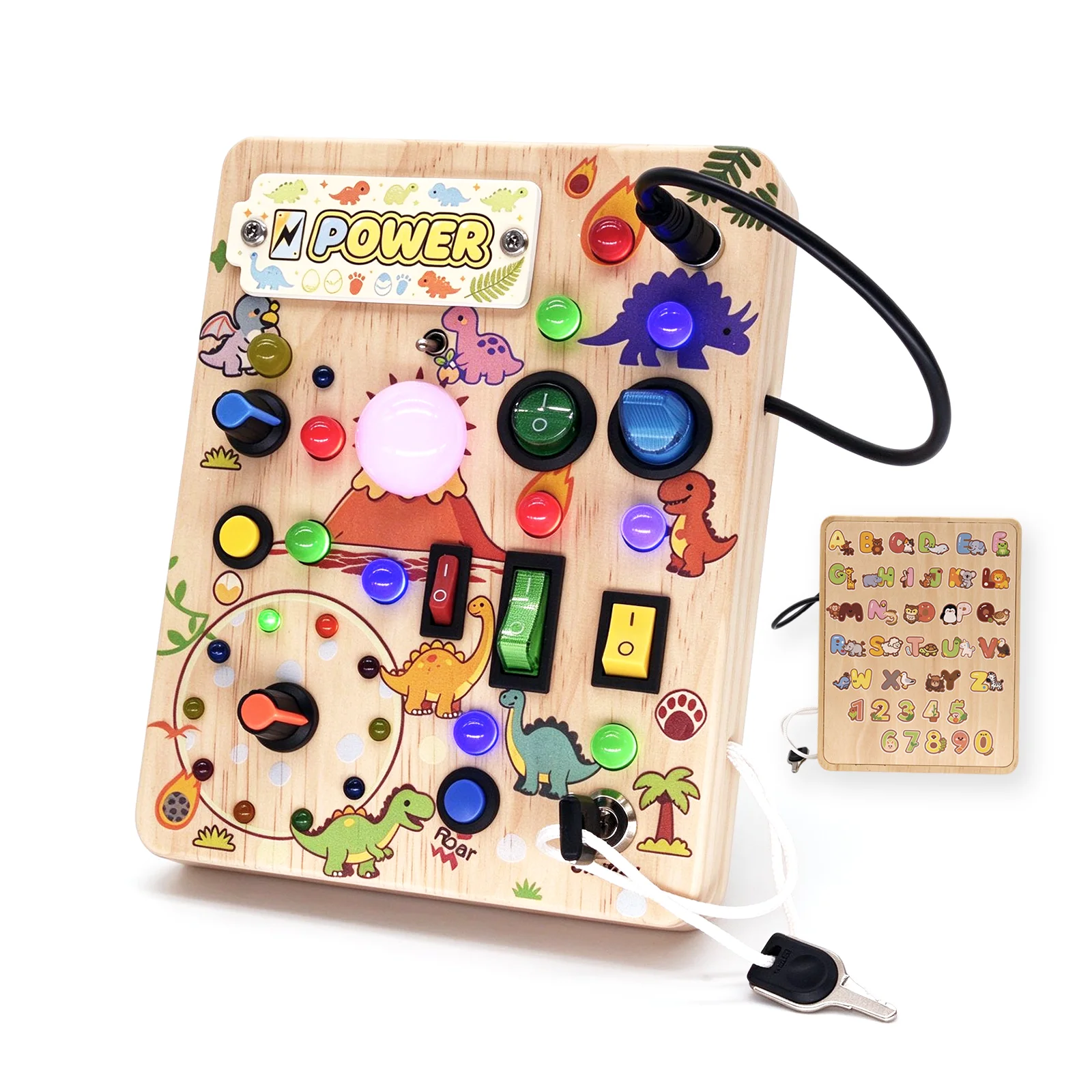
Our range is built on one platform (12 switches, 23 LED modes) and differs by artwork and the back panel, so you can build a range without separate tooling for each line.
| Model | Front panel | Back panel | Indicative FOB |
|---|---|---|---|
| Classic | Classic activity board with 12 switches and lighting | Basic engraving | ~8.90 USD |
| Alphabet | The same LED platform | A–Z and 0–9 engraving | ~9.20 USD |
| Dino | Dinosaur on the front panel | Letter engraving | ~9.50 USD |
The final price depends on body size, LED count, the switch set, packaging and printing, so treat 8–10 USD per unit as a starting range at MOQ.
Retail at 20–35 USD and where the margin comes from
The gap between 8–10 USD at the factory and 20–35 USD on the shelf is where your costs and profit live: freight and duties, printed packaging, in-market logistics, the marketplace and advertising. Calculate margin per shelf, not per unit — a printed box with your own barcode turns a shipping case into something that goes straight onto the shelf without repacking. We support colour box printing, your own barcode and private label, so packaging can be priced into your first batch. We covered how retail, marketplace and education channels value a light-up board differently in our piece on LED boards for retail.
How to sell a light up busy board: short video and live demo
For this category video matters more than people admit, and the light-up version is stronger. The reaction is instant — press it, it lights up — and the first 1–2 seconds decide whether a clip gets watched. The board needs no explaining: the light shows the function by itself, and unboxing plus the child's first reaction make a ready-made script. Better still, 23 lighting modes give material for several videos from one board. A live demo board with batteries in it sells itself on the shelf and online: the child switches, the light answers, and the parent stops.
Common quality pitfalls that eat your margin
Most problems here are about the electronics and the finish, not the wood. On the sample, check for single-point light from cheap bulbs with no mode set; no master switch, a direct route to "can't turn it off" reviews; an accessible battery compartment, a listing block and a safety risk; plywood instead of solid wood, meaning smell and a tired look after three months; and sharp edges from skipping sanding. We use solid natural wood, not veneered plywood, and sand the edges with rounding: a board with a 4% return rate and an "it smells" review isn't a cheap board — it's an expensive one.
MOQ, samples and lead times
Samples run 1–10 pcs in 3–7 days, on a refundable deposit fully credited against your first bulk order — you cover only shipping. Always inspect a physical sample: photos hide the edge finish, the switch feel and the glow. MOQ is 100 pcs per model for catalogue lines, 200 pcs for your own artwork or laser engraving, and 500–1000 pcs for full OEM; mixed batches are normal, and we plan the container loading around your range. Production takes 15–25 days after deposit and artwork approval. Where wholesalers lose time is usually the packaging artwork, not production — if the product must be on the shelf by a fixed date, start with the artwork.
Order a sample and a quote for your range
If you're entering the light-up busy board market or extending a line, Binobie is our own factory in Wenzhou (Zhejiang Province, China): we manufacture wooden LED busy boards for B2B export and work with 15+ countries. We can give you an indicative FOB price of 8–10 USD per unit at MOQ, tailored to your configuration; samples of 1–10 pcs in 3–7 days, cost credited against the bulk order; CE / CPC / ST test reports for current models; colour box printing, your own barcode and private label; and a photo report before every shipment with a 15–25 day lead time. Take a look at the model catalogue to choose between Classic, Alphabet and Dino, then write to us with your destination country, volume and preferred configuration, and we'll come back with a price calculation and sample terms. The full range and supply terms are on our site. Start with a sample — it will tell you more about the product than any quote.
Related reading
- LED busy board materials guide — why the build matters
- LED vs traditional boards — which to stock
- custom and OEM options — own-brand LED boards