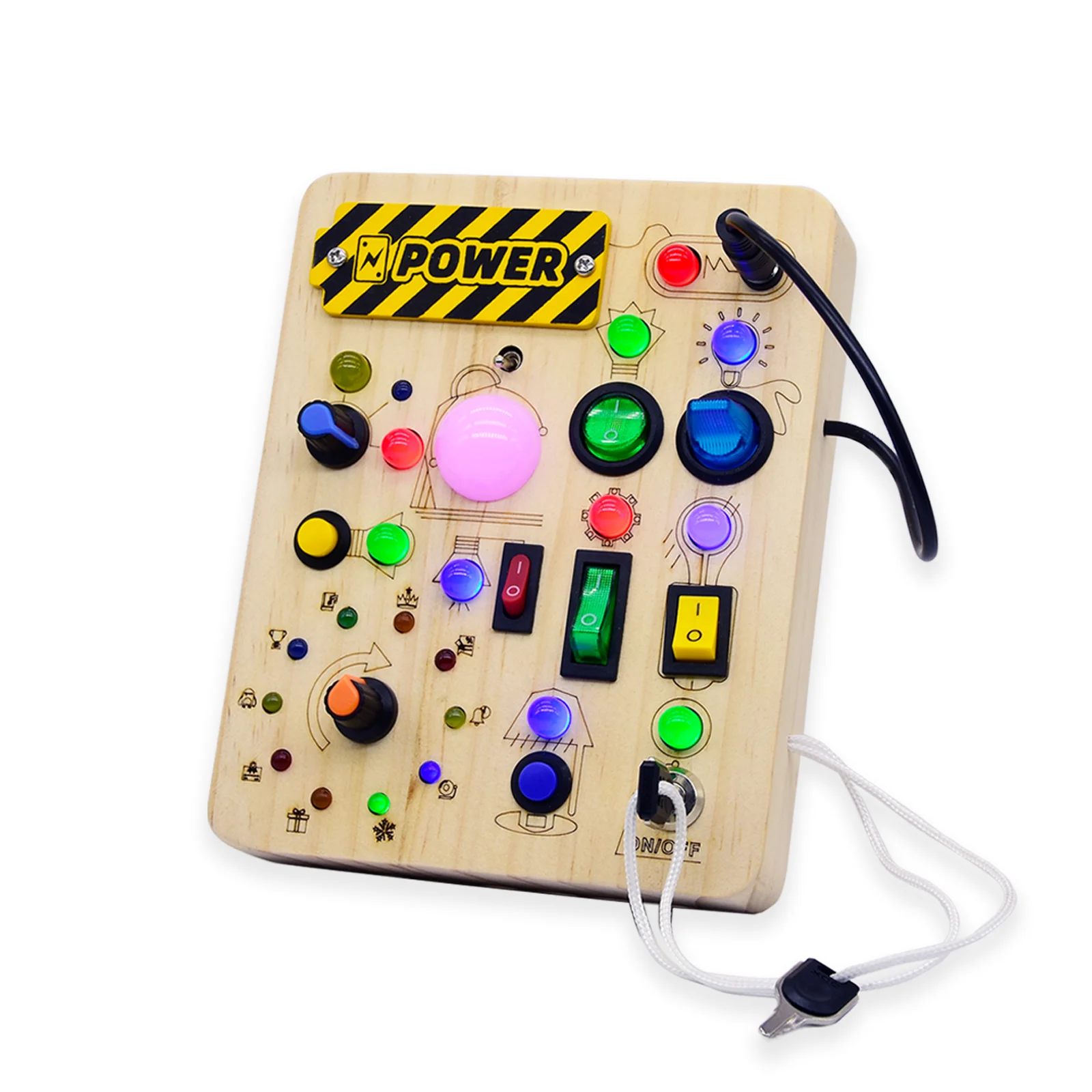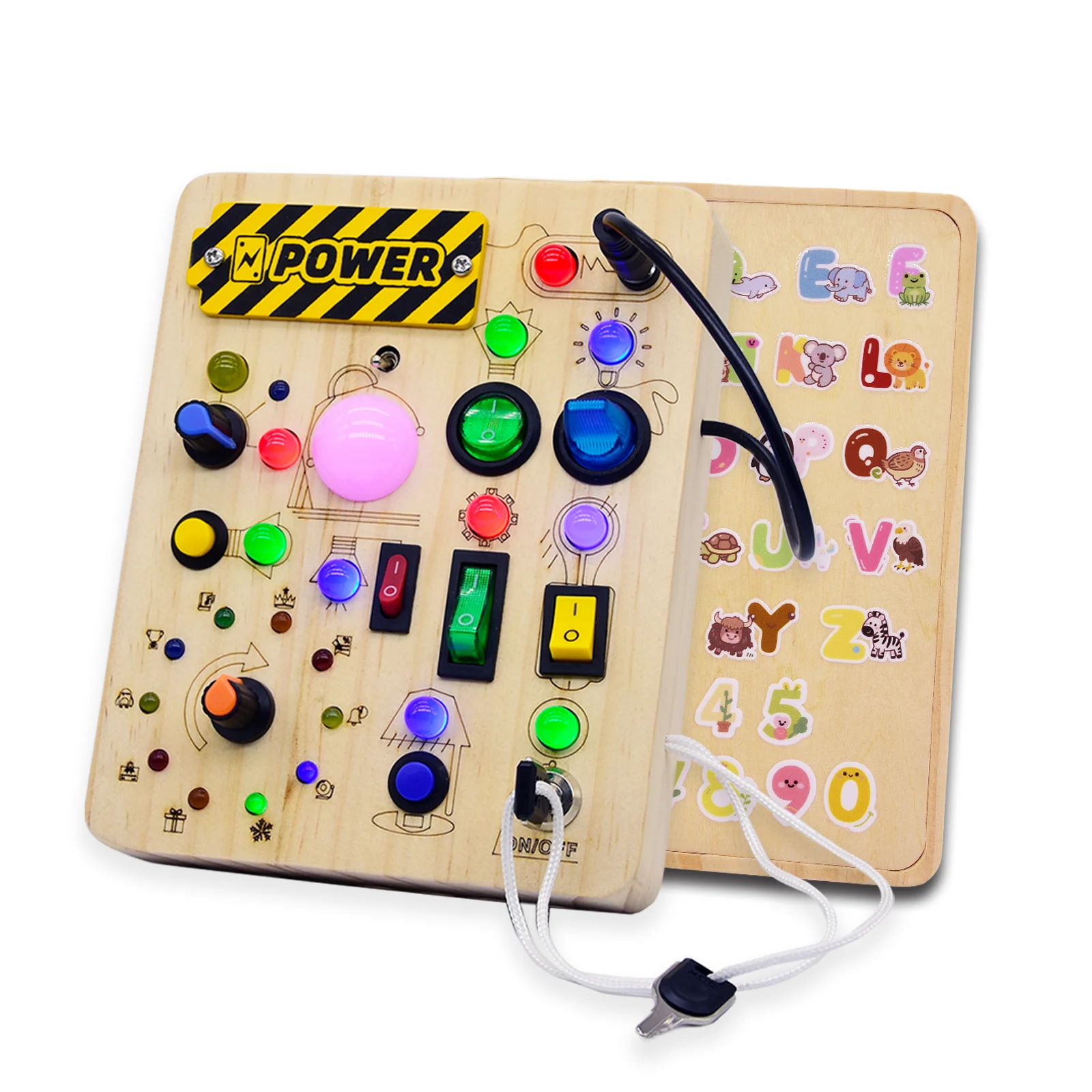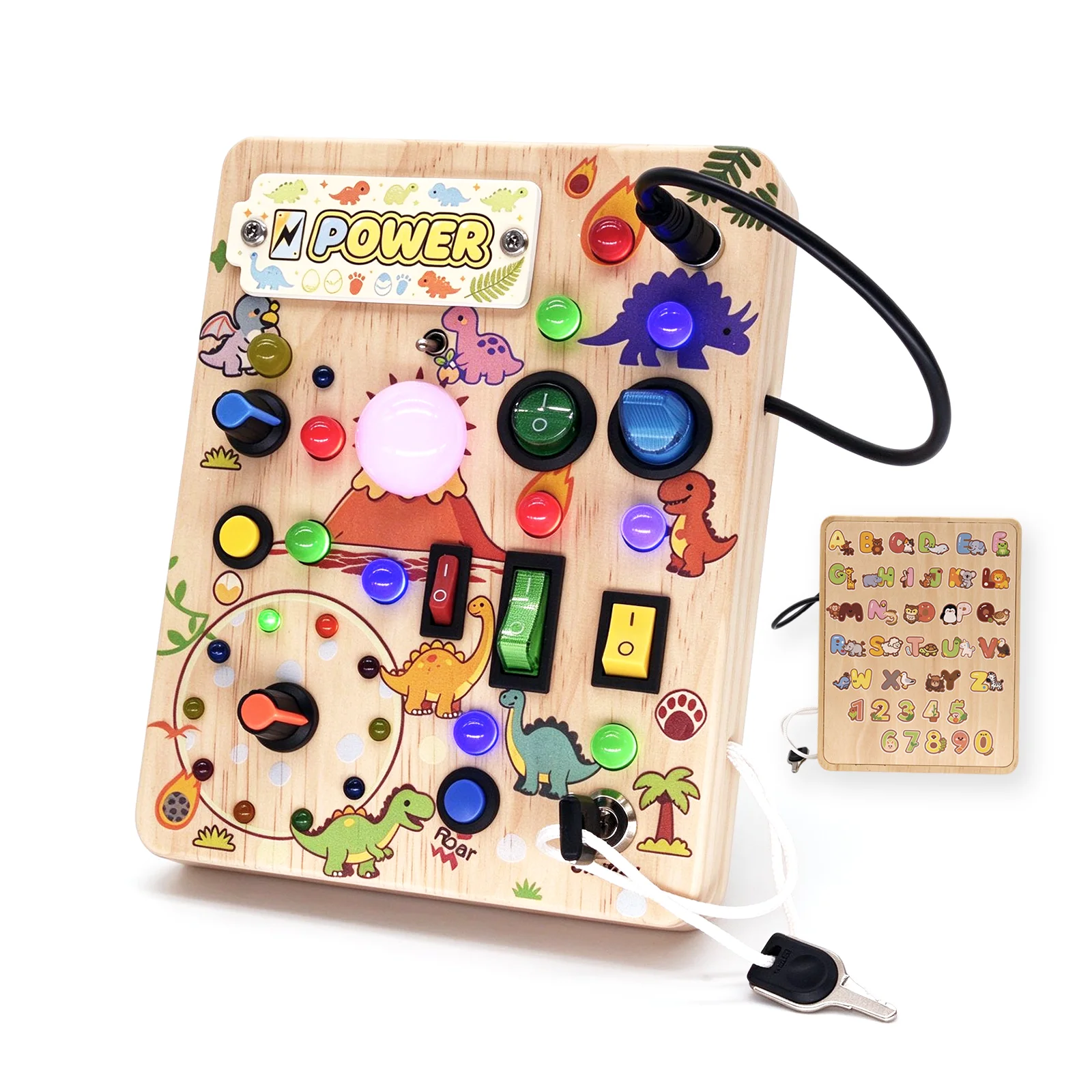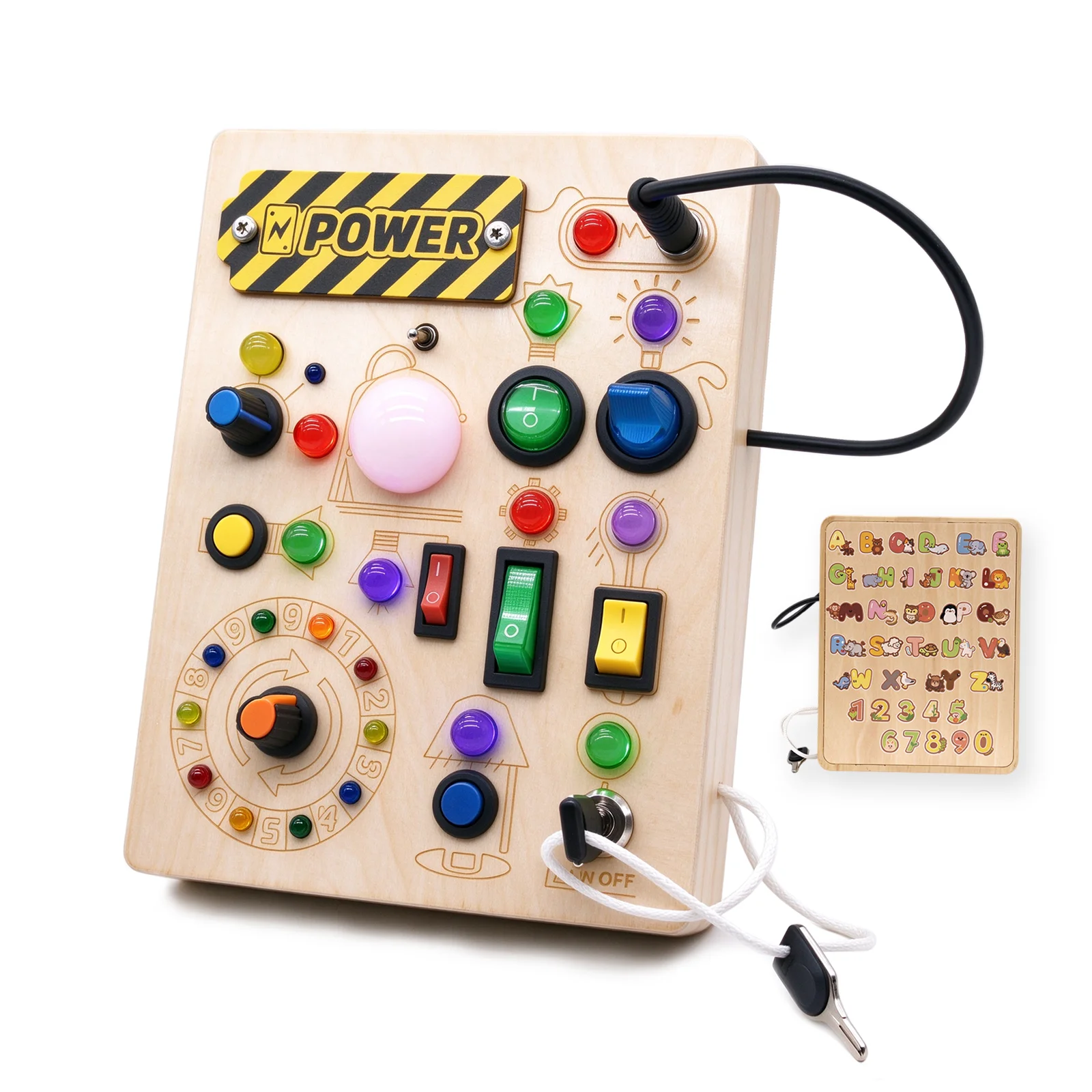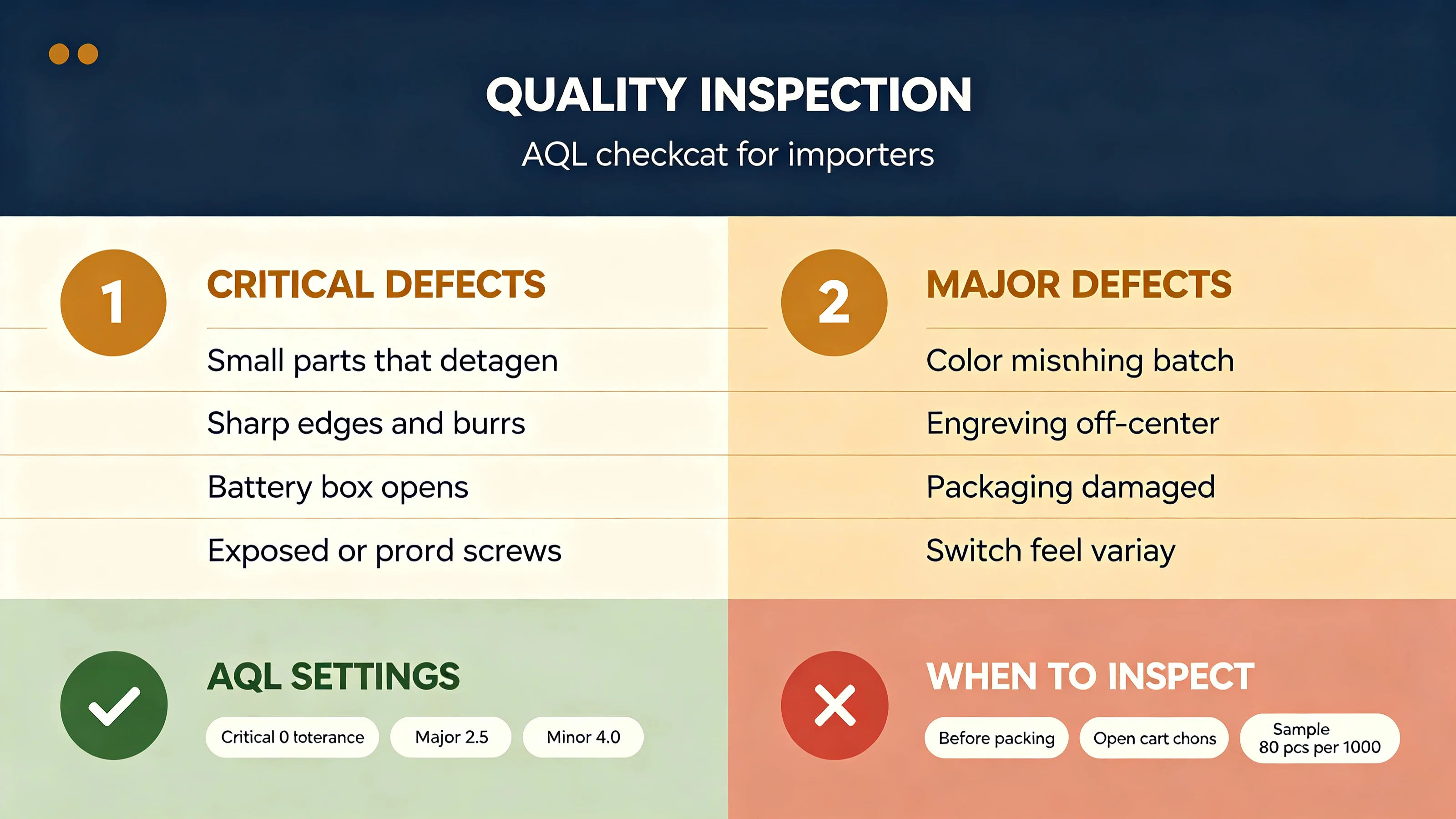
Short answer: a busy board quality inspection under AQL decides whether a batch ships by judging a small sample of it. For busy boards most importers run critical defects at zero tolerance, major defects at AQL 2.5, and minor cosmetic flaws looser still. On a 1,000-piece order you'd typically pull around 80 units; at AQL 2.5, up to 5 major defects pass and 6 fail the batch. What follows is the checklist and the process we'd hand a buyer standing on our own floor, so weigh it knowing we're the factory and have a stake in a smooth inspection.
A busy board looks simple from across a room. Up close it's a wooden panel carrying electronic switches, moving hardware, small caps and a battery compartment, and it gets handed to a two-year-old who will taste all of it. That combination is why a busy board quality inspection matters more here than on a plain wooden puzzle. A switch that works on the sample and sputters in the batch, or a screw that backs out in a nursery, is the kind of thing that turns one order into a recall.
Quick facts
- MOQ: 100 pcs standard · 200 with your own artwork or engraving · 500–1,000 for full OEM
- AQL we build against: critical 0 · major 2.5 · minor 4.0 (a common starting point; your spec, your call)
- Samples: 1–10 pcs, 3–7 days, credited against the bulk order
- Lead time: 15–25 days after deposit and artwork approval
- Certifications: CE / CPC / ST reports on current models (EN 71, ASTM F963)
- FOB at MOQ: $8.90 Classic · $9.20 Alphabet · $9.50 Dino
What AQL means, and how to read the table
AQL is short for Acceptable Quality Level. It's the defect rate you're willing to live with on a batch, written as a percentage and paired with a table that tells you how many units to pull and how many defects are too many. You don't inspect everything. You sample, count, and let the table decide ship or hold.
Two inputs drive the sample size: how big the lot is, and which inspection level you pick. Level II is the everyday default. Bigger lots get bigger samples, but the sample grows far more slowly than the lot, so you rarely pull more than about 200 units however many you ordered. Defects are then sorted into classes, and each class gets its own AQL: critical for safety or legal problems, major for things that hurt the sale, minor for cosmetics. One batch, three verdicts.
The tables themselves are standardised, so a third-party inspector and your supplier are reading the same numbers. What isn't standard is the AQL you choose, and where you record it. Put it in the purchase order and the spec sheet before production starts. An AQL that only exists in an email thread is an argument waiting to happen.
A worked example: 1,000 pieces, 80 sampled
Say you ordered 1,000 boards and agreed to level II. That lot usually lands on a sample of 80. Now set three numbers. Critical at zero means any single critical defect fails the batch. Major at AQL 2.5 means accept up to 5, reject at 6. Minor at AQL 4.0 means accept up to 7, reject at 8. Here's the shape across a few lot sizes, the common plans on ISO 2859-1 / ANSI Z1.4. Check the exact figures against your own AQL table and the level you've agreed, because moving the level moves every number, and your chosen AQLs move them again.
| Lot size | Sample (level II) | Critical (AQL 0) | Major (AQL 2.5) | Minor (AQL 4.0) |
|---|---|---|---|---|
| 281–500 | 50 | 0 allowed | accept ≤3 / reject ≥4 | accept ≤5 / reject ≥6 |
| 501–1,200 | 80 | 0 allowed | accept ≤5 / reject ≥6 | accept ≤7 / reject ≥8 |
| 1,201–3,200 | 125 | 0 allowed | accept ≤7 / reject ≥8 | accept ≤10 / reject ≥11 |
To make it concrete: pull 80 boards, find zero critical, 4 major and 6 minor, and the batch passes all three classes. Find 6 major defects and it fails, even if everything else is clean. That's why the numbers go in the PO first. The decision becomes arithmetic instead of mood.
Critical defects in a busy board quality inspection
These are the ones that stop a shipment. A critical defect is a safety risk or a legal problem, and on our line we treat the count as zero. Walk the sample against this list:
- Small parts that can detach. Screws, caps, knobs and pegs a child can pull off and swallow. The relevant rules sit in EN 71 and ASTM F963, and they're the same ones behind most toy recalls, so what each safety mark actually covers is worth reading before you approve a model. Test with a hand-pull, not a glance.
- Sharp edges and burrs. Every edge and corner should be rounded and sanded. Run a fingertip along each one, and a tissue if you want a second opinion.
- A switch that does nothing. Flip every switch on the sample; each should do something you can see, whether it moves a part or lights a lamp.
- LEDs that don't light, or light on and off. A weak solder joint often shows only after a switch is worked several times, so exercise each one rather than testing it once.
- A battery compartment a small child can open. It should need a screwdriver or a coin, or a latch a toddler can't work. Two fingers and it opens, and it fails.
- Paint or lacquer that smells sharp. A strong solvent smell usually means the finish isn't fully cured or isn't compliant. You can't fix chemistry by airing out cartons for a week.
- Exposed or proud screws. Hardware standing above the surface, or that you can loosen by hand, is a hazard and a common complaint.
- Cracked or split board, or separating layers. Check the panel ends, the switch cut-outs, and the corners where stress concentrates.
Any of these turning up in the sample holds the batch until someone explains it.
Major defects: they cost sales without endangering anyone
A major defect doesn't threaten a child. It threatens your margin, because the customer who opens the box notices, and the ones who notice leave reviews. The usual suspects:
- Colour that doesn't match within the same batch. One carton slightly darker than the next reads as cheap on a retail shelf.
- Engraving or printing off-centre. A name or logo drifting toward the edge makes a custom order look rushed.
- Packaging crushed, torn or water-marked. A damaged box becomes a damaged return, and what survives a courier is not always what survives a container. We go through that side in our guide to busy board packaging and shipping.
- A missing manual or insert. Small, easy to miss in the sample, guaranteed to generate customer emails.
- Switch feel that varies across the board. A toggle that's stiff next to one that's loose makes the product feel inconsistent even when both work.
Minor defects, and the point where they add up
- A faint scratch on the back panel, away from the play surface.
- Slight colour drift in box printing between cartons.
- Natural grain or tone differences in the wood.
One or two of these in a sample is normal for a wood product, and chasing zero would cost real money for no return. The trap is the pile-up. If your 80-unit sample shows 30 minor flaws, something on the line or at the paint station is drifting, and the major count is probably not far behind. Watch the minor column as an early warning, not as a pass-or-fail.
When to inspect, and who should do it
A busy board quality inspection happens at one of two natural moments, and you have three ways to put eyes on the floor. Getting both right is most of the job on a first order.
Before packing or after
Before packing is usually the better call, especially on a first order. The units are open and reachable, the wiring is visible, and any rework happens before cardboard and inner trays are spent. You also see the product as it comes off the line, not as it was packed by whoever was fastest that shift.
After packing has one real advantage: it tests the packaging, where a lot of avoidable damage starts. If shipping damage has burned you before, inspect the finished cartons and open a few to check the inner protection.
For a large or repeat run, many importers add a during-production check as well, early enough that a systematic fault can still be fixed without scrapping the batch.
Three ways to get eyes on the floor
You fly out yourself. Best signal, and on a first order it's worth it if the value justifies the trip. You meet the line, you see the wood, you learn what normal looks like here. The cost is flights, hotels and your own time.
You hire a third-party inspection company. They arrive with a standard checklist, produce a photo report with verdicts, and charge by the man-day, commonly in the low hundreds of dollars per inspector per day, depending on the country. Independence is the main selling point. The catch is that they check against the checklist they brought and the standard you specified. If your PO didn't name the AQL, their report can pass a batch you wouldn't have. Give them your spec, not theirs.
You rely on the factory's own report. We send these, and you should treat them as a starting point rather than a verdict. It's the graded party holding the pen, including with us. What a self-report is good for is catching the obvious and documenting what left the building. It's weak at the subtle. If your order is small and the model is one you've bought before, a self-report plus a fresh sample from the run can be enough. If it's your first order or a new model, it usually isn't.
What to photograph while the cartons are open
An inspection without evidence is just a memory, and memories lose to time zones and turnover. Whatever route you choose, make sure a busy board quality inspection leaves these in your inbox before the balance is paid:
- The sample laid out and labelled, with the date and the lot number visible.
- A close-up of every defect found, with a clean unit beside it for scale.
- A short video walking the finished cartons before they're sealed.
- The container or truck seal number, photographed in place.
- Carton counts and the packing list, matching the quantity you're paying for.
None of it is paperwork for show. If a dispute ever reaches a freight insurer or a chargeback, this set is what settles it.
Rework, discount, or reject after a failed busy board quality inspection
When a batch fails, you have three levers, and the right one depends on how bad the defect is and how tight the ship date is.
Rework is best when the defect is fixable and the schedule has room. The factory reopens the cartons, reworks the units, and you re-inspect before final payment. Agree in advance on who eats the cost. If the defect was ours, it's ours. If it came from a spec change after production started, that's a different conversation.
Discount is the realistic middle path when the defect is cosmetic or the shipping window can't move. The mistake is accepting a discount that doesn't match your real downstream cost. A batch of slightly off-colour boxes isn't worth much off the unit price if your retail customer sends it back. Price the discount against returns and reviews, not against the invoice. The figure you're arguing over is small next to your unit economics, which our breakdown of what drives your cost per unit puts in context.
Reject is the strongest lever and the one to hold in reserve. It's cleanest on critical defects or a batch that simply can't be sold, and it's far stronger when you still owe the balance.
If you've already paid the deposit
This is the honest part. A 30% deposit is, in practice, hard money. It paid for material and setup, and asking for it back is a fight you'll usually lose, whatever the contract says. So plan around the balance instead.
The practical move is to make the balance conditional. Hold it, name the rework, agree a re-inspection, and if a small residual defect remains, keep back a percentage as a quality reserve for 60–90 days. That gives the factory a reason to finish the fix, and gives you something to point to if a customer complains. What you should not do is pay the balance to keep things moving and hope. That's the moment your leverage disappears.
The factory view: half of what you'll call a defect is a standard difference
We'll say the uncomfortable part. Wood is not uniform. Two panels from the same board of beech differ in grain, and a finish that looks amber under our workshop lights looks a shade different under yours. A print that sits a millimetre off centre is a defect to a designer and invisible to a shopper. When you flag these, you're often arguing about taste, and taste has no AQL.
That's not us dodging the safety list above. A loose screw or an uncured finish is a real defect with a real rule behind it, and it should fail the batch. The trouble is that "defect" and "difference" get mixed together, and the mixing usually starts because nobody wrote the line between them.
The fix is boring and it works. Put the defect classes and the tolerances in the purchase order and on the approved sample before production. Then the inspector is measuring against a document you both signed, and the factory can't shrug at a flaw by calling it nature. Build in a drawing or a photo of the acceptable range for grain, colour and print position. It costs an hour at the start and saves two arguments later. Much of this overlaps with certification, since the tested model number should sit in the same document. Our guide to choosing a busy board supplier covers the paperwork you want on file before the first order runs.
Questions buyers ask us every week
What AQL should I put in my purchase order? Critical at zero, major at 2.5, minor at 4.0 is a common starting point and what we'd suggest until you have history with the product. If returns are expensive in your market, tighten the major figure. If you're sampling a new SKU cheaply, you can loosen it, but loosen it on paper, in advance.
Should I inspect before or after packing? Before packing on a first order. You catch wiring and finish problems while the units are still open, and you avoid paying to repack. Add a finished-carton check if shipping damage has bitten you before.
Is a third-party inspection worth it on a 100-piece order? Usually not on its own, since the man-day fee can run a meaningful share of the order value. If you've bought the model before and trust the line, a self-report plus a fresh sample can carry a small reorder. For a first order or a new model, an inspector is cheap insurance.
The factory says the flaws are normal tolerance. Who's right? Whoever put it in writing first. If your PO named the defect classes and the tolerances, the answer is in the document. If it didn't, you're both right and both stuck, which is why we push buyers to write it down before production.
What if I already paid a deposit and the batch fails? Don't pay the balance until the fix is agreed. Hold the balance, specify the rework, re-inspect, and keep back a reserve if a small defect remains. Chasing the deposit back is usually harder than using the balance as leverage.
Can I just trust the factory's own inspection report? As a record of what shipped, yes. As a verdict on quality, no, because it's the graded party holding the pen, including with us. It's fine for a reorder you already trust. It isn't a substitute for your own eyes, or an independent pair, on anything new.
What we'd do in your position
If this is your first busy board order, write the AQL and the defect classes into the PO before you send the deposit, approve one sample against that document, and book a pre-packing inspection. Fly out if the order is large enough to justify it. If it isn't, use an inspector with your spec rather than theirs. Spend the two weeks at the start getting the paperwork right, and the rest of the relationship gets easier.
If you're switching from a supplier who keeps drifting, don't switch only on price. Switch on the inspection trail. Ask for the last inspection report, the self-report, and a sample from the current run before you commit to volume. A supplier who can produce those on request is usually the one you want to keep.
And if you want our report before your inspector's, ask for it with your target quantity, port and packaging spec. We'll send it in the format above, next to a quote you can put beside whatever else is on your desk. The import itself is the straightforward part, and we walk new buyers through it in how to import busy boards from China.
If you are still deciding on the shape of this order, three pages go further: Busy Board Safety Certifications Explained: EN71, ASTM F963, CE & CPC (2026) on the supply side, Toy Safety Compliance in the EU: CE & EN71 in Practice on the quality side, and How to Choose a Busy Board Supplier: A 12-Point B2B Checklist when the quote is on your desk.