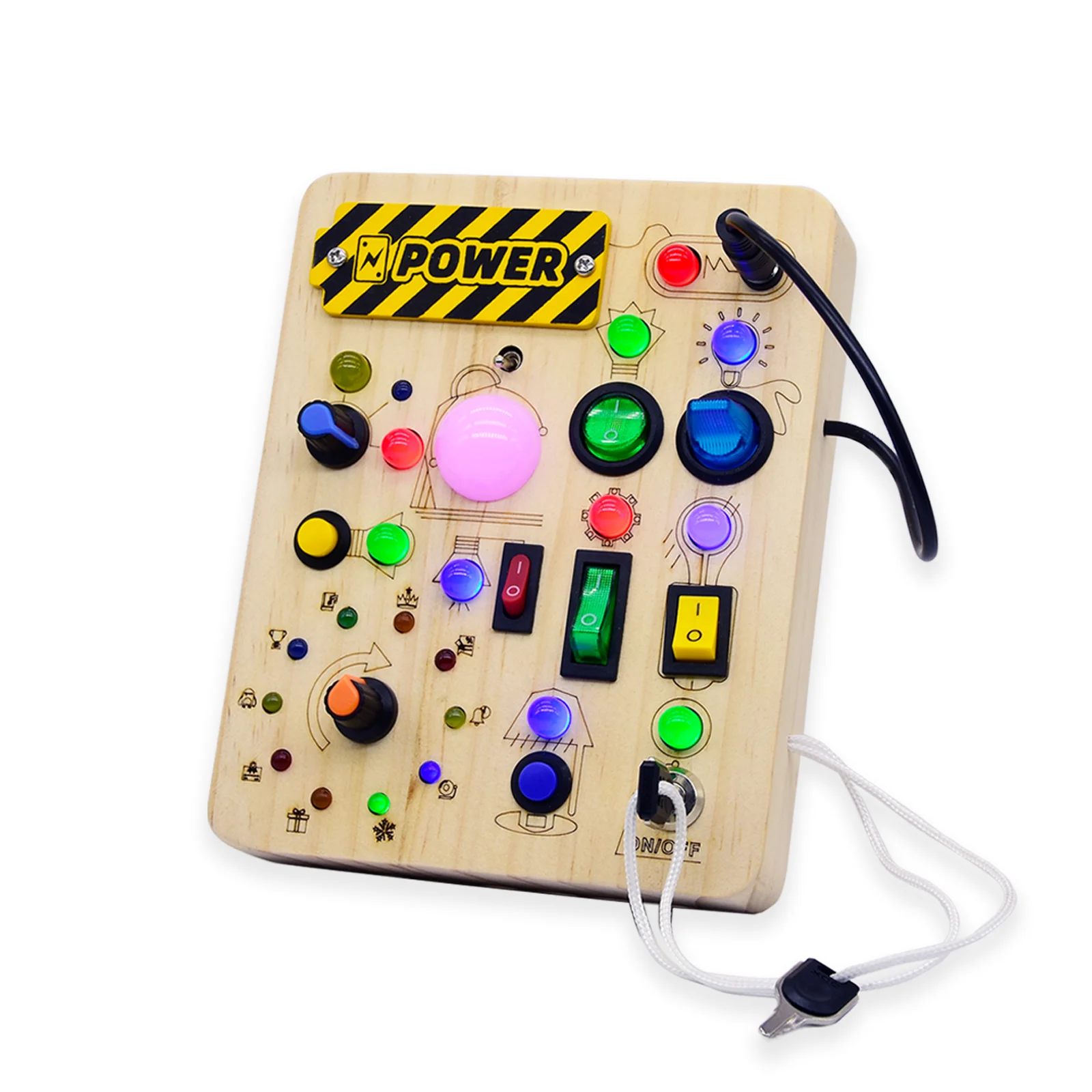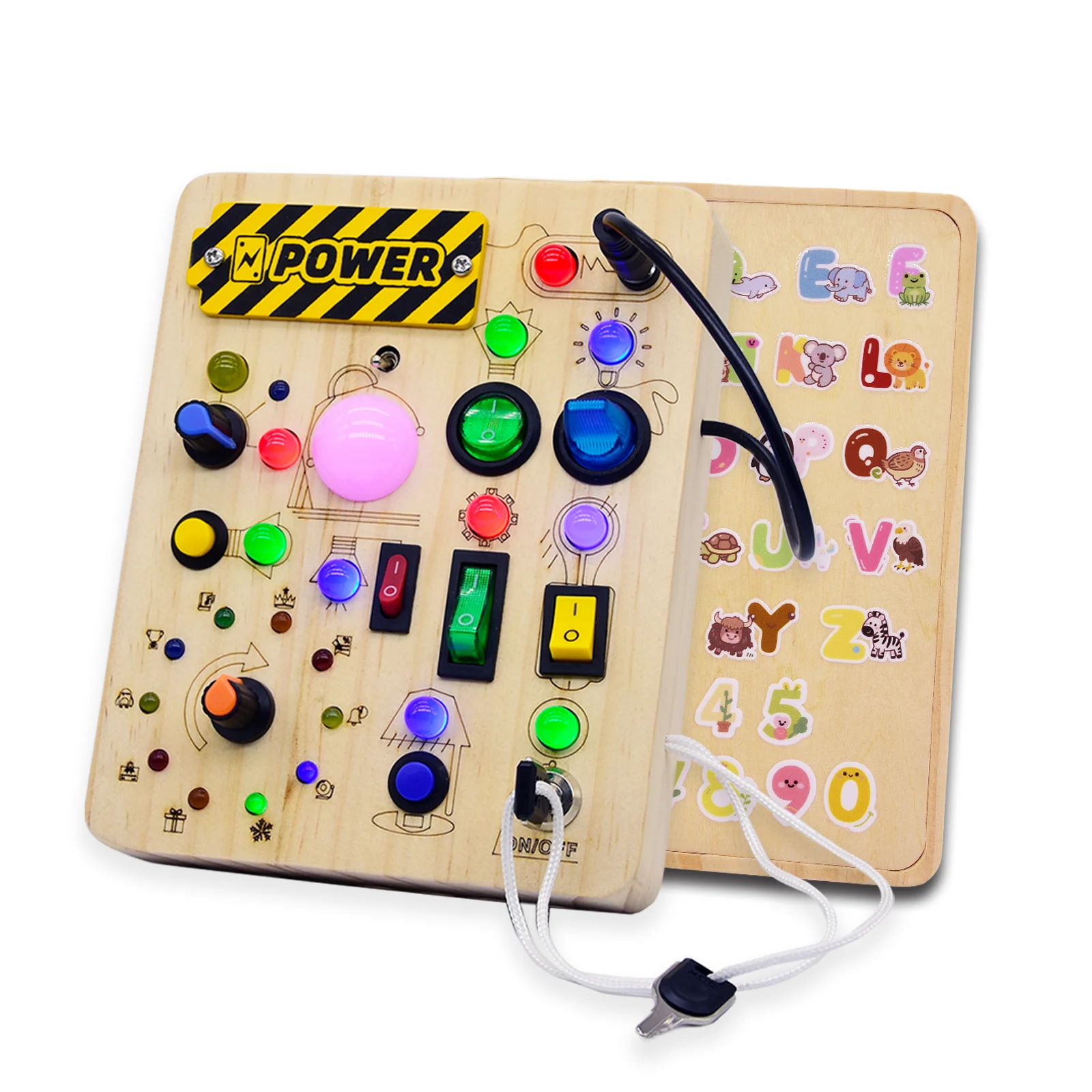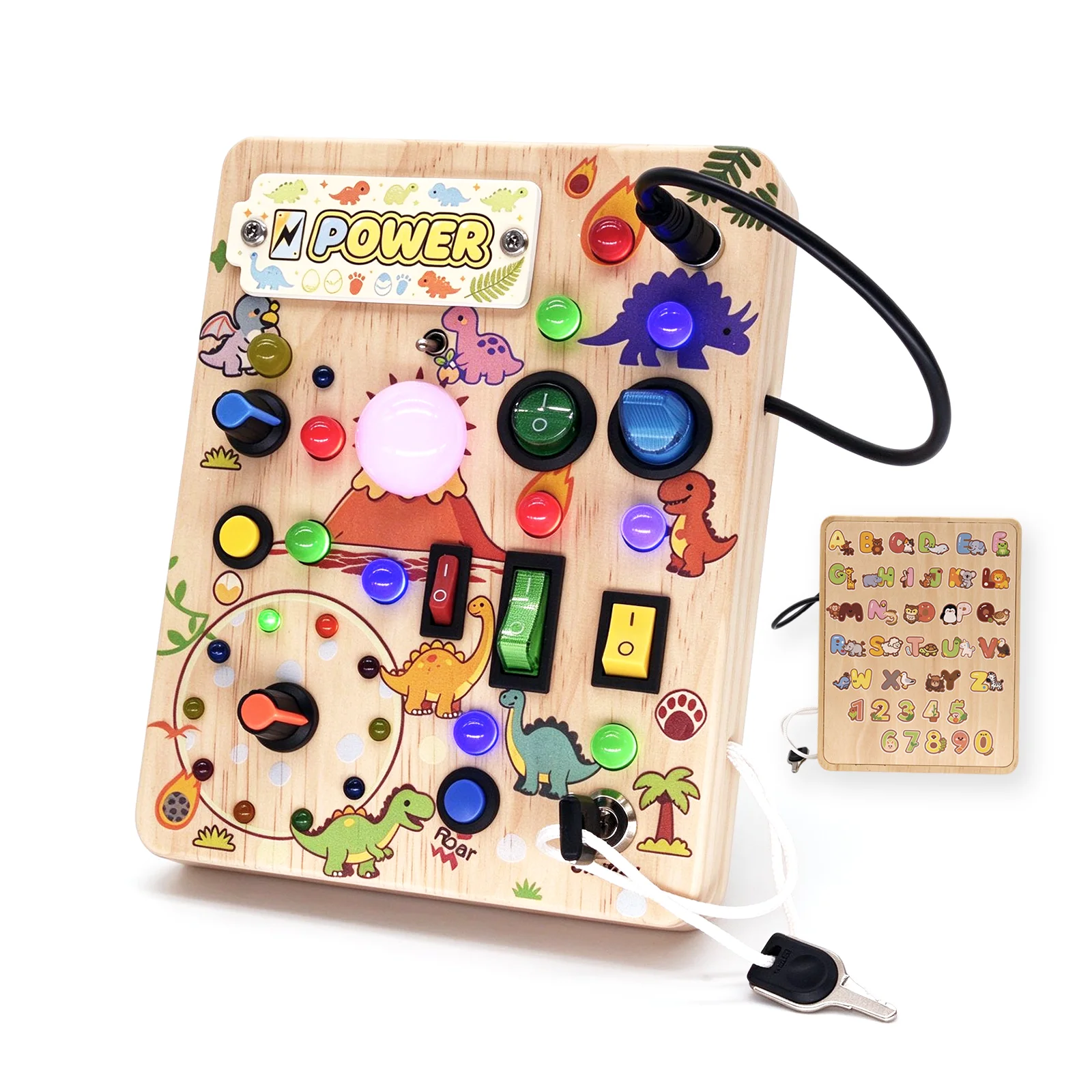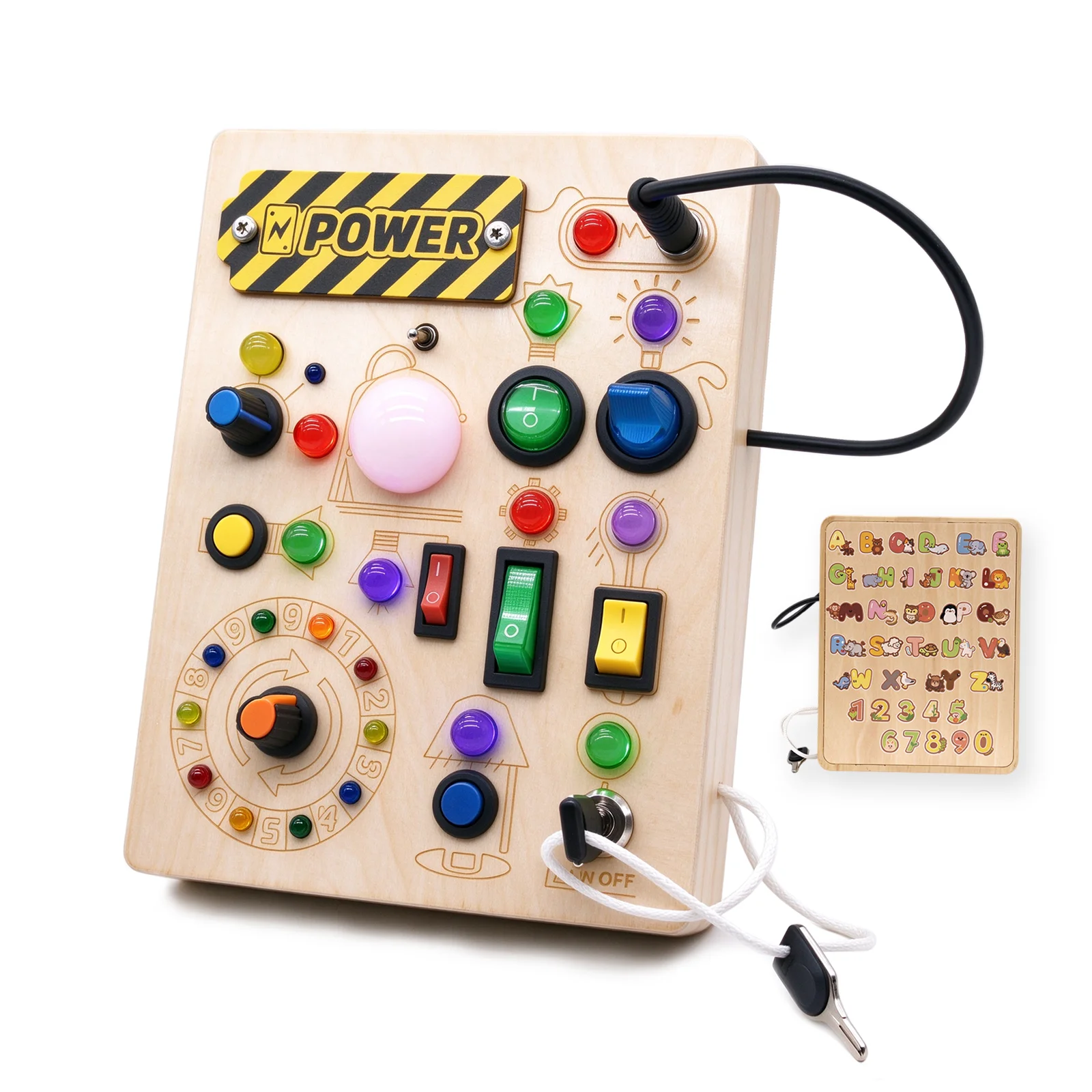
Short answer: when a buyer asks us whether the busy board vs sensory board vs fidget board split matters for their range, we tell them it describes two products and three audiences. The busy board and the sensory board are frequently the same wooden panel sold under two names, and the honest dividing line is what the child's hand actually does when it touches the surface. A fidget board is a different customer, and sometimes not a child at all. Sort your range by build and by buyer and the shelf stops cannibalising itself.
We're a factory in Wenzhou and we make wooden LED busy boards. Some of our buyers list them as busy boards, others as sensory boards, and both descriptions survive a product audit because the boards genuinely do two jobs. That loose labelling is exactly why a distributor can send back a spec sheet asking what the difference is supposed to be.
The naming on the carton is the least reliable thing you have. The build, the age band, and the certification file are what you're really buying. Below is how we separate the three names, who each one is for, and what we'd actually put on a shelf.
Quick facts
- MOQ: 100 pcs per model · 200 pcs for custom artwork or engraving · 500–1,000 for full OEM
- FOB at MOQ: $8.90 Classic · $9.20 Alphabet · $9.50 Dino
- Samples: 1–10 pcs, 3–7 days, credited against the bulk order
- Lead time: 15–25 days after deposit and artwork approval
- Certifications: CE / CPC / ST on current models, tested to EN 71 and ASTM F963
- Recommended retail: $20–35
Busy board vs sensory board: the difference is in the build, not the label
A busy board is a panel with things to operate. Latches, zippers, buckles, rotary dials, toggles, switches, and on our line a light that answers back when a switch moves. The hand has a job and an order to do it in: flip this, then slide that, then the light comes on. Fine motor work gets a visible reward, and that reward is why a board with a working light system holds a two-year-old far longer than a board of dead latches.
A sensory board is a panel with things to feel. Fabric, silicone, fleece, crinkle film, ribbon, texture tiles, and sometimes a soft tactile face stretched over a wood frame. Nothing is operated. The hand rests, presses, strokes, and the point is the contact itself rather than a result. You see these mostly in occupational therapy rooms and in retail aimed at parents of children who need tactile input.
The real difference is that on a busy board the child performs, and on a sensory board the child registers. One is measuring fine motor progress; the other is supplying tactile feedback a nervous system is asking for. That distinction is why therapists buy the two for different reasons, and why a panel with both a latch row and a fabric strip can carry either name without anyone lying to you. Frame it as busy board vs sensory board and you're really asking one question about the front panel: is the hand meant to operate something, or to feel something?
This is also where the light system earns its cost. The same board with and without lights is a different product for a different child, and a buyer who can't tell them apart in a photo will price them as if they were interchangeable.
Busy board vs sensory board vs fidget board: three audiences, three buying motives
The names blur because the audiences overlap at the edges, but the purchase motives are not the same, and neither are the reasons these products come back. That's why a busy board vs sensory board vs fidget board decision is really a decision about people, and it's worth taking one audience at a time.
Younger children: development
This is the busy board customer. A parent of a one to four year old buys an activity surface to keep hands busy in a car, a queue, or a waiting room, and to practise the small movements a child is working on anyway. What parents of one-year-olds are actually buying is time and a bit of quiet, not a curriculum. This buyer returns a board when it's too easy, too hard, or simply boring after a week, and "boring" is most often a switch-count and switch-variety problem rather than a defect.
Special-needs and sensory buyers: regulation
This is the sensory board customer, and it includes parents, occupational therapists, and school districts. Their motive is not entertainment, it's regulation. They want a surface that gives predictable tactile input, withstands daily handling, and can be cleaned without falling apart. This buyer returns a product over shedding fibres, a silicone edge that peels, a fabric face that changes after washing, or a cleaning instruction that turns out to be untrue. They reward a supplier who answers material questions precisely and punishes one who can't. Our wider notes on the sensory toy category cover how that channel expects to buy.
Adults: focus and anxiety
This is the fidget customer. A fidget board is built around undirected, repetitive motion: a spinner that keeps turning, a toggle that clicks, a tactile pad that gives the same feedback every time. The buyer is often an adult dealing with focus, restlessness, or anxiety, and the product lives on a desk rather than on a nursery floor. The motive is comfort and attention, and the return reason is expectation: an adult buys a calming tool, it doesn't calm them, and it comes back the same week. We cover the care-market end of this in busy boards for dementia and elderly care, which is where the audience stops being children altogether.
Where the three cannibalise each other on the shelf
Here's the part buyers underestimate. Consumers search "sensory board" and "busy board" as if they were synonyms, which is the busy board vs sensory board mix-up showing up later as lost sales. A parent standing in front of three near-identical wooden panels does not compare specifications. They buy one. Put all three on the same shelf at the same size and you've split one demand across three SKUs, lowered each one's apparent velocity, and made your category look weak to a category manager who only sees rotation.
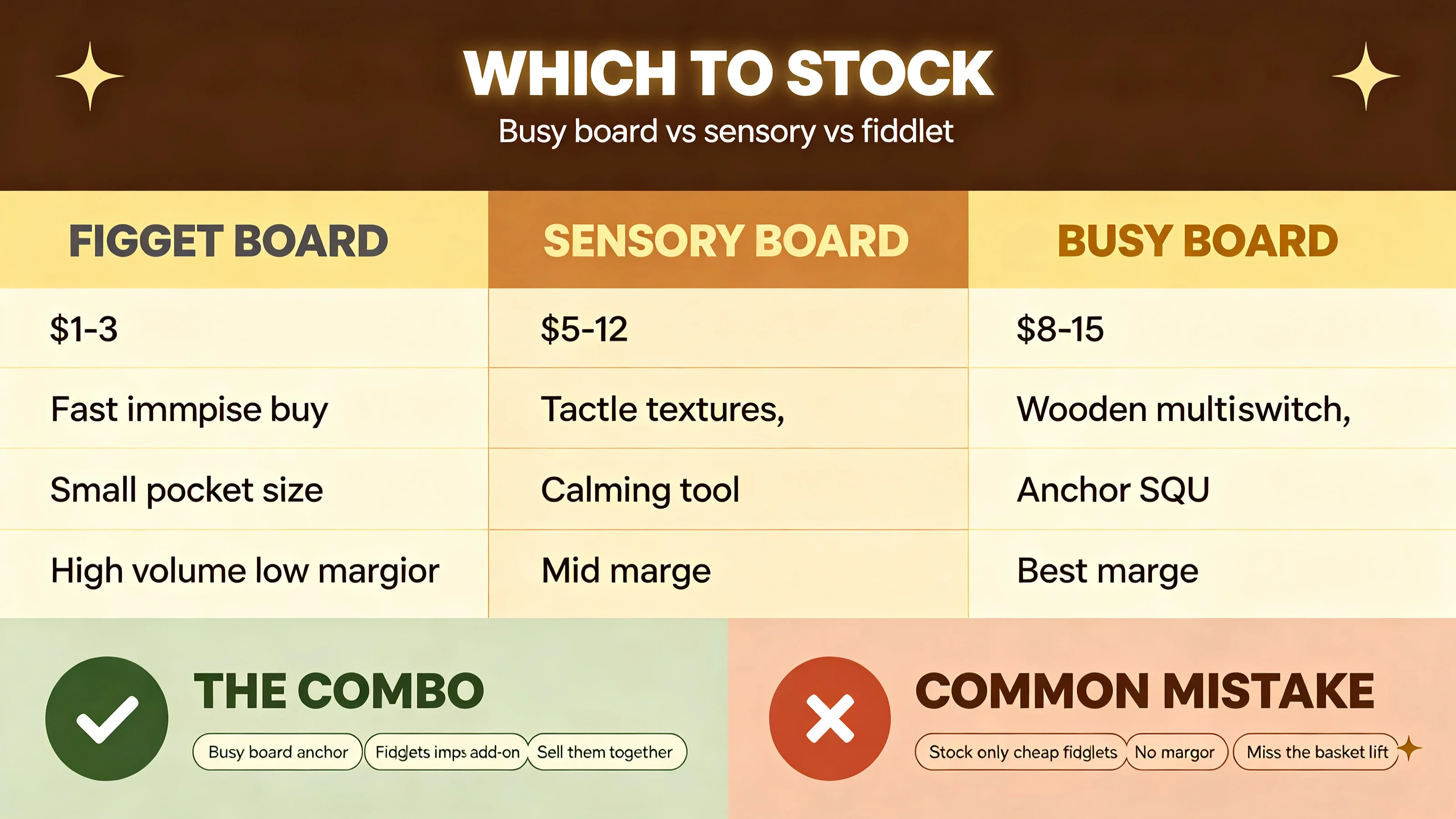
The rule we give buyers is simple: stock two, not three, unless you have three genuinely separate channels. A general toy retailer with one shelf should carry a wood busy board as the anchor and a small fidget item as a counter or check-out add-on. The textile sensory board is a specialist product and belongs to therapy and special-needs channels, where the buyer already knows why it exists. Keeping a fabric sensory panel in a general toy aisle usually leaves it sitting while the busy board it looks like does all the selling.
Stock all three only when the audiences are physically separated: a toy shelf, an education or clinic catalogue, and an adult focus or wellness section. Same product family, three different buyers, three different reasons to exist. When those buyers sit in the same aisle, the third SKU doesn't add a third customer, it just reprints the second one.
Price, turnover and returns: what each category costs you
The three names behave very differently once they're selling, and a busy board vs sensory board vs fidget board mix shows up fastest in returns rather than in price. The bands below are the ranges we see in our own export channels and from buyers comparing notes, so treat them as typical rather than fixed.
| Category | Typical retail band | Repeat purchase | Return pressure | Role on a shelf |
|---|---|---|---|---|
| Busy board (wood, switch-led) | $20–35 | Gift-driven, repeats on the age step-up | Moderate; boredom or transit damage | Anchor item, the one people photograph |
| Sensory board (textile-led) | $25–45 premium; institutional priced per order | Low in retail, steady institutional rebuys | Moderate to high; washing and shedding claims | Margin item for therapy and special-needs channels |
| Fidget board (small, motion-led) | $6–15 | Highest; small and repeat, adults buy more than one | Highest when the buyer is wrong about the audience | Traffic item, impulse and check-out |
Three things fall out of that table. The sensory board tends to carry your highest average order value because it sells into institutional and premium retail buyers who order in larger lots, and it earns that value with materials and therapy credibility rather than electronics. The fidget board has the best repeat rate we see, because it's small, cheap, and bought in multiples, which makes it a reasonable basket-builder next to a bigger ticket. And the fidget board also carries the highest return rate, and the reason is almost always the same one: it was sold to the wrong audience. An adult calming tool bought for a five-year-old, or a child's toy bought by an office worker expecting it to be a desk object, comes back nearly every time. Our own cost breakdown per unit, model by model, sits in the busy board wholesale price guide if you want the FOB side of these numbers.
Compliance: the three names don't sit under the same rules
Certification is where the naming stops being cosmetic and starts costing money, and it splits the three names into three sets of paperwork.
Start with the boards sold to children. If the product is designed for play by children under fourteen, it's a toy and it needs a toy file: EN 71 in the EU and ASTM F963 in the US to support CE and CPC. Our current models carry CE / CPC / ST reports against those standards, and the model number on the report has to match the model you're actually buying. A report for last year's panel proves nothing about this year's.
Then the fidget line, which trips up buyers every season. A fidget tool marketed to adults as a focus or stress device is often not a children's toy at all, so it doesn't automatically need EN 71 testing, and asking a supplier for a "toy certificate" on an adult desk object is a sign you're confused about what you bought. The object doesn't change, the paperwork does, based on how you position it. If your packaging shows a child, your listing says ages 3+, or you place it in a toy category, regulators will treat it as a toy and will want the file you didn't ask for. Decide the audience first, then buy the matching certification.
The soft-material question is the last one. The moment a sensory panel uses fabric or silicone instead of wood, you inherit a different set of tests. Textiles bring colourfastness, flammability, and after-wash behaviour; anything a child may mouth brings migration testing on the soft materials, the same way wood coatings are checked for migration under EN 71-3. The practical buyer's version is simpler: if the box says wipe-clean, the fabric has to survive wiping, and if it says machine washable, it has to survive the wash without pilling or shedding. We've watched more sensory returns come from an optimistic cleaning claim than from any single material fault.
What buyers get wrong (the ones we see most)
Listing a wooden switch board as a sensory board and then failing a marketplace attribute check, or getting a request for a textile test file the wood model never needed. The label you choose sets the expectations you'll be held to.
Assuming fidget means toy, ordering accordingly, and then discovering that the adult version needs a different positioning and a different file, while the child version needs the full toy package.
Buying one sensory sample with a soft face and pricing it like the wooden board, without accounting for the cleaning, migration, and material questions that came attached to that face.
Comparing FOB across all three as if they share a bill of materials. They don't. A small fidget piece and a 12-switch light board are not comparable line items, and sorting them by price alone will mislead you on margin.
Ordering all three at MOQ 100 each to "see what sells", then sitting on the two that don't move and calling the category slow. Testing needs one flagship, not three.
What we'd do in your position
Start from your channel and your buyer, and let the naming follow. The busy board vs sensory board question answers itself once you know who's standing on the other side of the register. A general toy retailer gets a wood busy board as its anchor, one SKU, one clear size, packaged for retail. A special-needs or education buyer gets a sensory board with therapy credibility and cleaning instructions that hold up, priced for that channel. An adult focus or wellness buyer gets a fidget item, positioned as a desk tool rather than a toy, with the paperwork to match that framing.
Then use the anchor to pull the other two. The busy board is the item people search for and photograph, so it earns the traffic; keep a small fidget piece at the check-out where that buyer is already standing, and let it build the basket. Bring in the sensory board only when a real therapy or special-needs buyer is asking for it, not because it looked good in a catalogue.
One last thing about the shelf itself. Don't price all three at the same point. Three near-identical panels at the same price teach a customer to pick the middle one and ignore the rest, which is the fastest way to make two of your three SKUs look dead. Different build, different audience, different price.
Questions buyers ask us every week
Can I sell one board as both a busy board and a sensory board? Sometimes yes, if the board truly has both a working switch row and a genuine tactile element, and if you're honest about which is doing the selling. What you can't do is call a plain light board "sensory" to chase a trend and then get asked for the material paperwork that name implies. The label is a promise about the build.
Which of the three has the highest margin? The sensory board usually, because it sells into buyers who accept a higher price for materials and credibility, and it's less exposed to price shopping than a commodity wooden board. The fidget piece has the best repeat rate but the thinnest unit margin. A busy board sits in between and does the most work for traffic.
Do fidget boards need children's toy certification? Only if you position them as children's toys. An adult focus tool typically doesn't carry the toy file, and a child's fidget product does. The trap is a listing that shows a child while the factory quoted you an adult item.
Should I stock all three at launch? Not into one shelf. Launch with your anchor and one add-on, learn what your buyer actually reaches for, then add the third only if a separate channel or audience is asking for it. Stocking three to test is how buyers end up with two slow SKUs and a distorted view of the category.
Is a fabric sensory board harder to import than a wooden one? It brings more questions rather than more obstacles. Cleaning claims, shedding, and migration on soft materials need real answers, and those answers take longer than a wood board where the surface is sealed and simple. Budget time for that, and buy a sample you can wash before you commit to a container.
Can one product line cover all three audiences? A well-built wooden board with a light system and a tactile strip gets you close to the busy board and sensory buyers, and it can be positioned toward older users too. It won't replace a dedicated fidget piece for the adult focus market, because that buyer wants small, quiet, and repetitive rather than a wall-mounted panel.
If you're not sure which of the three belongs on your shelf, send us your channel, your buyer, and your target retail price. We'll tell you which build fits and which one you can leave out, and we'll quote it in the same format as the tables above so you can put it straight into your range plan.
Two more angles on this: Sensory Toys Wholesale: How Busy Boards Fit the Category covers the sourcing end, LED Busy Board vs Traditional Busy Board: Which Sells Better for Retailers covers what buyers ask about first, and Essential vs Classic: Which Busy Board Fits Your Market? (Affordable Busy Board Wholesale, 2026) is the one we send when someone asks for the whole picture.