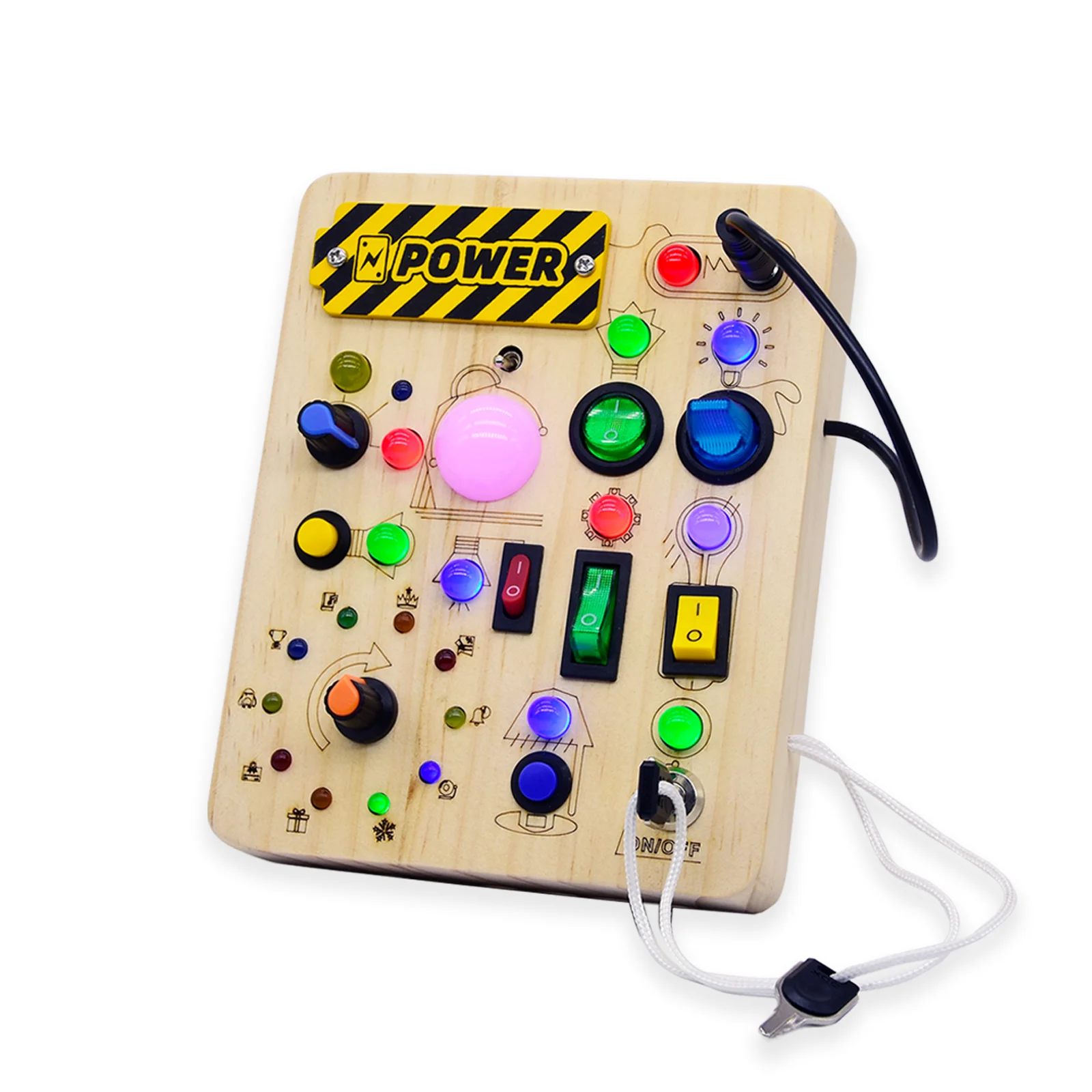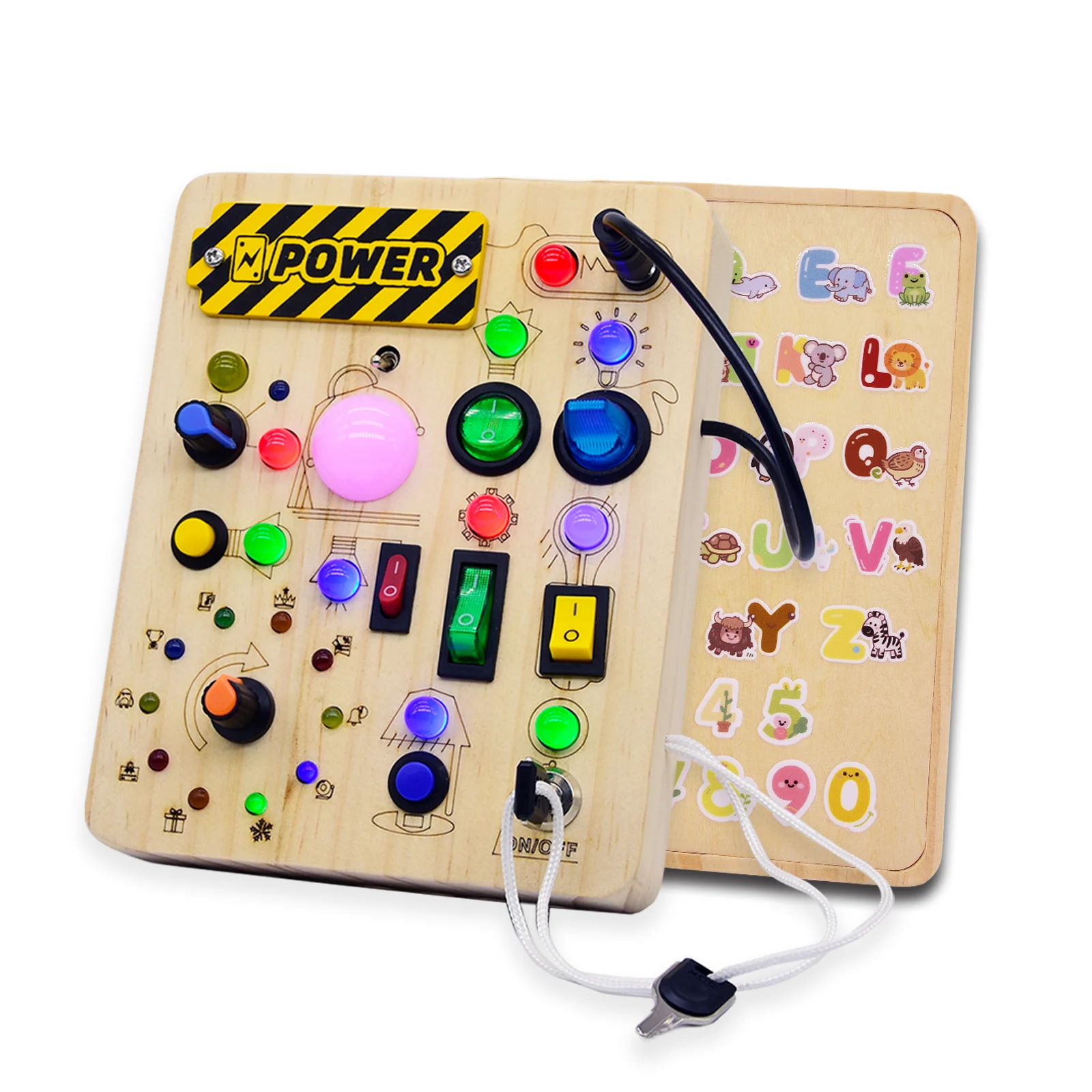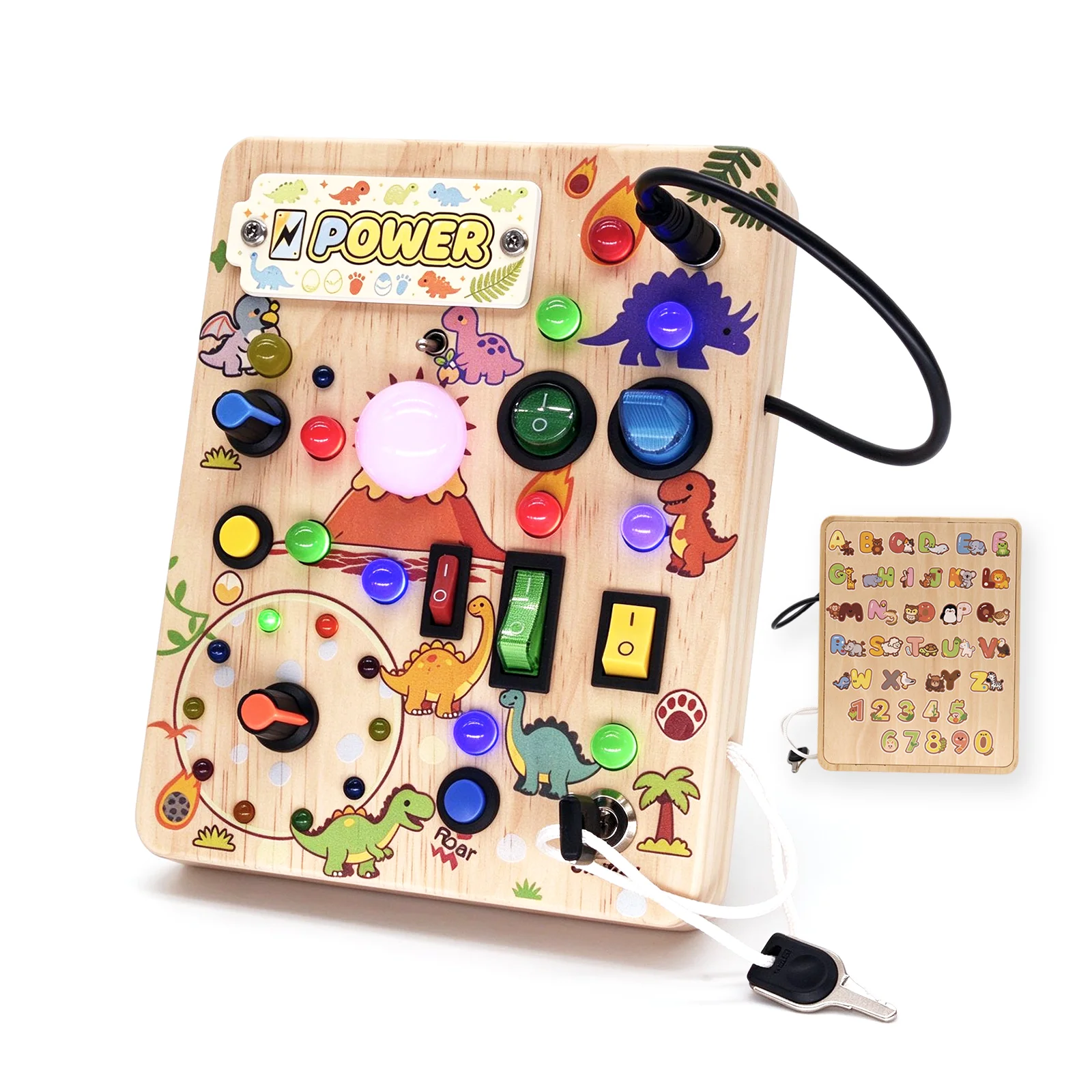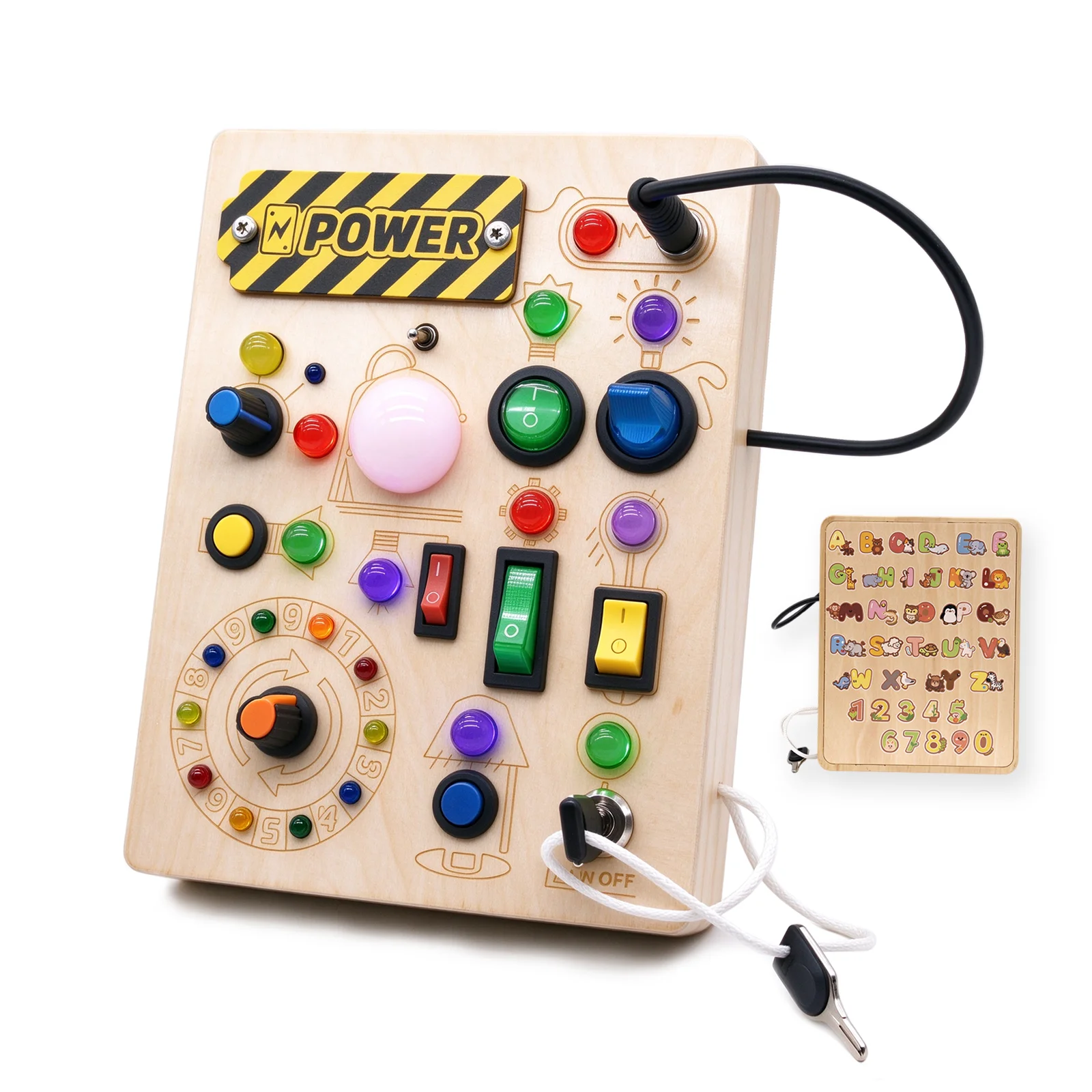
Short answer: a busy board for 1 year old is not your standard board with a younger age sticker on the box. Part size, switch resistance, cord length, surface finish and the whole certification path change once the user is twelve to twenty-four months old. Get that wrong and you don't end up with a slightly imperfect toy. You end up with a customs hold, a recall risk, and a return rate that quietly eats the margin the low price was supposed to protect.
Most buyers who write to us about the 1-year segment are chasing a real opportunity. It is the biggest gift price band in the category, and it sells on feeling faster than almost anything next to it. It also comes back more often than the 3+ boards, for a reason that has nothing to do with build quality: the child can't work it yet, and the adult who bought it blames the product.
We build our boards in Wenzhou and we are the factory. Some of what follows is a warning about our own category, so read it knowing where we sit.
Quick facts
- MOQ: 100 pcs per model · 200 pcs with your own artwork · 500–1,000 pcs for full OEM
- Samples: 1–10 pcs, 3–7 days, credited back against the bulk order
- Lead time: 15–25 days after deposit and artwork approval
- Certifications: CE / CPC / ST reports on current models, tested to EN 71 and ASTM F963
- FOB at MOQ: $8.90 Classic · $9.20 Alphabet · $9.50 Dino
- Recommended retail: $20–35
What a one-year-old actually does with a board
To buy into this age band you have to know what the child can physically do, because that is what the board has to survive.
Between twelve and twenty-four months the hand changes quickly. A one-year-old wraps a fist around a knob and pulls. By eighteen months they can pinch with thumb and finger and begin to twist. They poke at anything with a hole in it. They push a button to see whether it does anything again, then again, then twenty more times, because the first idea this age locks onto is cause and effect.
Then there is the part buyers forget: everything goes into the mouth, constantly, and with force. A board that is safe on a shelf is not automatically safe in the hands of a child whose main tool for exploring it is their teeth. A one-year-old doesn't inspect a paint edge; they chew it.
None of this is unusual. It is the ordinary brief for the age group, and a completely different brief from the one a three-year-old gives you. The three-year-old presses a switch to make something happen. The one-year-old presses it to find out whether their hand caused anything at all. That difference is where every product decision here starts.
Why a busy board for 1 year old is a different product
A busy board for 1 year old and a board for 3+ can look identical in a photo. In the box they are engineered differently, and the difference is not cosmetic.
Our standard board carries twelve mixed switches and a controller with twenty-three light modes, and we sell it as 3+. Buyers ask us almost every month to put a 1+ sticker on it for the gift market. We usually decline. The board a genuine one-year-old can handle safely is a different build, made for a lighter hand and a shorter reach. That resemblance is exactly why it gets mislabeled.
Picture the two as serving two jobs. The 3+ board rewards a child who can already reason about what a switch does. The 1-year board rewards a child who is still learning that their hand causes anything at all, and it has to be forgiving the first fifty times it is used badly. If a supplier sends you one board with a broad age range printed on the box, they are handing you a compromise and trusting that nobody will test it.
What a busy board for 1 year old must not have
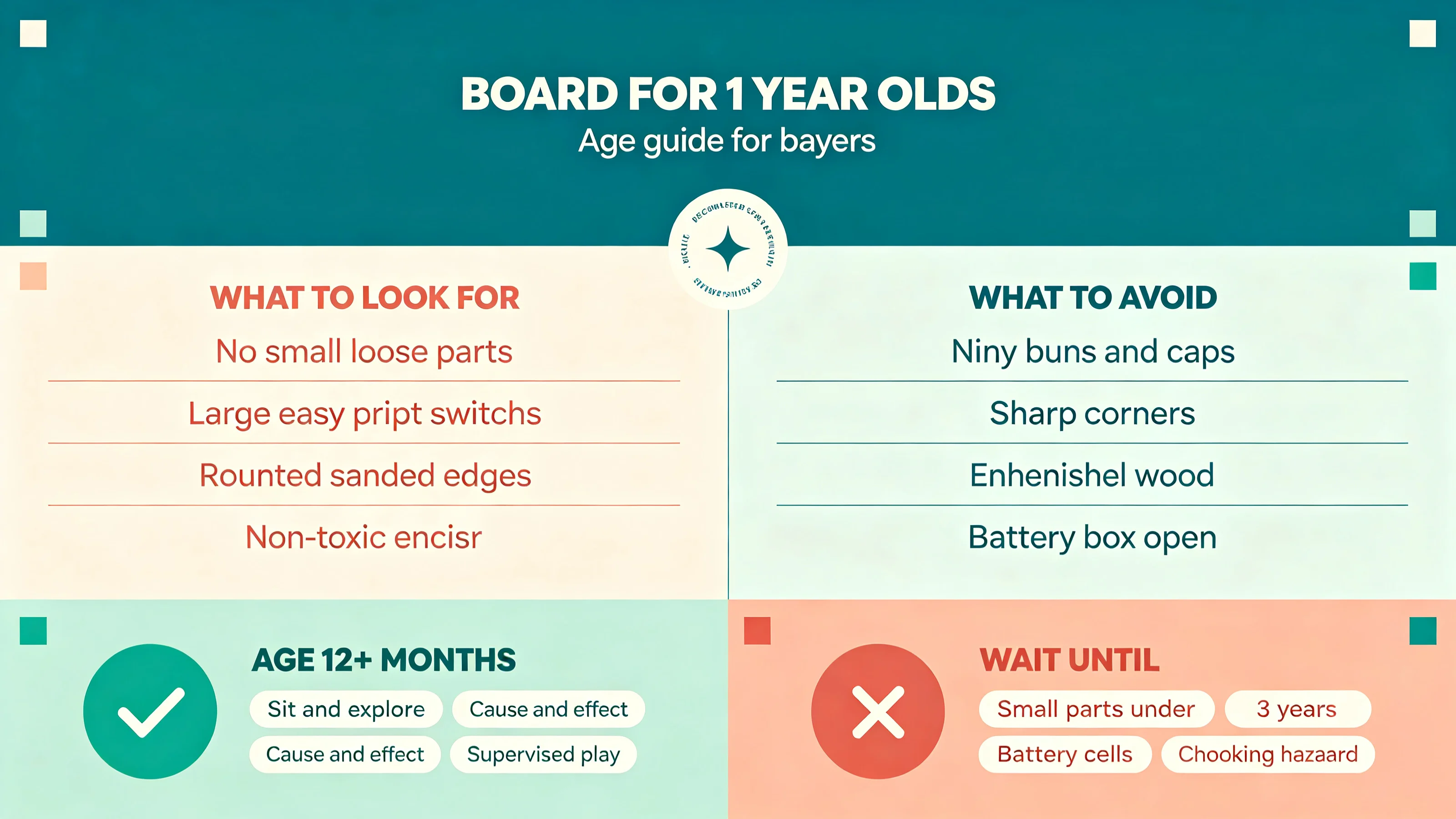
This is the list we go through with any buyer before we will quote a 1+ SKU. It is deliberately a list of absences, because in this band the safest board is the one with the fewest ways to fail.
Small parts and the swallow test
A child of twelve to twenty-four months mouths everything, and the throat at this age is narrower than most buyers picture from a photo. Any part that can be gripped, twisted off, unscrewed or pulled free is a risk. That rules out loose screws, push-on caps, beads, and decorative pieces that are glued rather than mechanically fixed. If a component can come away, it has to be too large to enter the mouth in the first place. "It's glued on tightly" is not a specification, and it is not what a test lab will accept.
Cords, loops and strangulation
Long strings are the quiet danger on toddler boards, and they show up in reviews far less than they should. A cord looped between two points, a lanyard, a handle strap left attached: any of these can tighten around a neck while an adult looks away for a second. For the 1-year band we design with no loose cord at all. Any pull element is short, fixed at both ends, and cannot form a loop large enough to pass over the head. Edge radius matters here too, because a child this age presses their face into the toy, not only their hands.
Switch force and feedback
This is the difference buyers notice first when they compare a 1+ sample against their existing 3+ board. A 3+ switch is built for a deliberate, fairly firm press. A one-year-old has less grip and less aim, so that same switch reads as broken to them. For this band you want a lighter actuation force and a clear click or light response for very little effort, so the board answers the child on the first attempt. We go deeper on the electronics in our comparison of LED and traditional busy boards.
Paint, coating and the mouthing phase
Because the board is going to be chewed, the surface stops being decoration and becomes a compliance question. Paints and inks have to meet the migration and heavy-metal limits in EN 71-3 and the equivalent ASTM requirements, and the supplier has to show the report for the finish actually used on the production batch rather than for a similar one from last year. "Non-toxic paint" is easy to type onto a purchase order. Proving it is harder, and the proof is what protects you when a claim lands on your desk.
The age label is a certification and liability decision
An age marking on a toy is a legal statement. It is not a marketing field you get to fill in once the box design is chosen.
In the EU under EN 71, and in the US under ASTM F963, a toy is tested and evaluated against an age grade, and the warnings and markings follow from that grade. Small-parts testing, for instance, is applied according to the age group the toy is intended for. Label a product for twelve months and older and you are telling the regulator and the lab that it meets the requirements for that band. Changing the sticker after the report is issued does not change the toy. It only makes the paperwork untrue.
That catches buyers in three places. A customs inspector or a market-surveillance authority who finds an age marking that does not match the test report can hold or reject the shipment. If a child is hurt with a mis-described toy, the age marking is one of the first things a claimant's lawyer reads, and "the factory told us it was fine" is not a defence you want to rely on. And on a marketplace, a listing that contradicts the certification on file can be pulled without warning. Which mark covers what is set out in our guide to busy board safety certifications.
We are not lawyers and none of this is legal advice. But we have watched buyers treat the age number as packaging art, and it is the quickest way to turn a decent product into an expensive claim.
Where the 1-year segment sits in your range
The busy board for 1 year old band is the strongest impulse price point in the category, and it is worth understanding why before you commit stock.
It anchors to gifting. A first birthday, a baby shower, a grandparent hunting for something that feels more solid than another plastic toy. The shopper is often not the parent, so the decision is faster and more emotional than in any other age band. At $20–35 retail a wooden board reads as a keepsake and clears the impulse threshold.
The downside is the same trait turned against you. Because the shopper is buying on feeling, they spend less time checking whether the child can actually use the thing. A one-year-old who cannot yet work a stiff switch puts the board down, the adult decides it was a bad buy, and back it comes. The board was fine. The age promise was wrong.
The 3+ segment behaves the other way: it sells more slowly, mostly to parents who have watched their child use one, and it returns less.
| Age band | Who buys | What drives the sale | What drives the return |
|---|---|---|---|
| 1 year (12–24 months) | Gifting adult, often not the parent | Occasion, keepsake feel, price point | Child can't work it yet: "won't use it" |
| 3+ (36 months and up) | Parent who has seen one in use | Prior experience, switch variety | Rare; wear and accidental damage |
The 1-year segment sells fast and returns more. Plan its price as if it were the other segment and the gap shows up in your margin two months later, after the reviews are already public. For how unit cost and retail price interact here, our wholesale price guide runs the same numbers we use on our own line.
The spec questions to ask before you order
You cannot judge a busy board for 1 year old from a photo, and you cannot judge it from a price. Put these questions to any supplier and write the answers in one column.
- What is the smallest part a child can grip, and is any part removable at all?
- What pull or tension force holds each fixed component, and do you have the test value?
- What is the cord length, and can any element form a loop that passes over the head?
- What is the switch actuation force, and does it produce an immediate click or light?
- Which paint and finish are used, and is there a migration and heavy-metal report for that exact finish?
- What age grade appears on the test report, and does it match the age marking on the box?
A supplier who sells honestly into this band will have all six answers ready. A supplier who can only quote a price is telling you something useful: they have not thought about the age group at all, and the sticker on the box was a sales decision.
Here is the comparison we show buyers when they ask what actually changes between the two builds:
| Spec | 1-year board (12–24 months) | 3+ board |
|---|---|---|
| Smallest removable part | None; every part mechanically fixed and above the swallow-size limit | Smaller parts permitted above the test limit |
| Cords and loops | No loose cord; nothing that can form a neck loop | Short fixed cords acceptable |
| Switch actuation | Light force, immediate click or light response | Firmer, deliberate press |
| Edge radius | Generous round-over; designed to be pressed against | Standard round-over |
| Surface finish | Coating tested for migration and heavy metals to EN 71-3 / ASTM | Coating tested to its own grade |
| Age grading | Tested and documented at 12+ months | Tested and documented at 36+ months |
None of these costs much on its own. Together they are the reason a board honestly built for a one-year-old cannot be sold at the price of a board built for a photo.
The return-rate trap we see every season
Nearly every return we hear about in this segment arrives with the same sentence: my child won't use it.
The board is intact, the parts are fixed, the lights work. What went wrong happened long before it shipped. A buyer took a 3+ platform, added a 1+ sticker for the gift aisle, and shipped it into a first-birthday market as a toy a one-year-old could drive on day one. On day one they can't. Their grip is weaker than the switch expects, so nothing happens, and the toy gets set aside. By the time the child could work it, three months later, the box is gone and a bad review is already posted.
We have had buyers come back to us mid-season over exactly this. Their return rate on the 1-year listing was running at several times the rate on their 3+ listing, and the reviews said the board was too hard rather than broken. The product was sold against the wrong promise, and the shopper who felt let down was never going to blame their own reading of the box.
The fix is mostly in how the product is presented rather than how it is built. Ship a 1+ SKU whose first switch is easy enough that the child succeeds inside the first minute. Then make the packaging and the insert say plainly what the board does at twelve months and what it will do at eighteen. A parent who is told to start with the easy switches and revisit the rest as the child grows does not return the toy when the harder parts wait. They keep it, because it now has a timeline.
Questions buyers ask us every week
Can I just relabel my current board as 1+ and save the redesign?
You can print the sticker, but the toy hasn't changed, and the report you would be relying on was written for a different age grade. If nothing is inspected, you get away with it for a while. If anything is inspected, the mismatch between the age marking and the test report is the first thing that gets noticed, and the one thing a buyer cannot argue their way out of.
Does a genuine 1+ board have to cost more?
A little, but not where most buyers expect. The extra sits in the increased testing, the lighter switch mechanism, the finish that has to be documented, and the insert that carries the age story. In our experience the per-unit difference is a small single-digit percentage. The expensive version is the cheap board that comes back.
What sells best at this age: lights, latches or shapes?
A mixture, and the light response does the heavy lifting early. At twelve months a child is chasing the cause, not the puzzle, so a board that answers their touch immediately holds attention longest. Latches and shapes start to pay off closer to eighteen months, which is one reason a good 1+ SKU grows rather than being a single fixed toy.
How do I cut returns when I can't control the child?
You control the promise, not the child. Put the easiest switch where the hand lands first, print a short "start here" line on the insert, and describe the twelve-month and eighteen-month stages honestly on the listing. Buyers return products that break a promise, not products that set a realistic one. Our Montessori wholesale buyers guide covers how this plays out across a whole range rather than a single SKU.
Will you certify a custom 1+ design?
We will, and it is worth doing properly. Bring us the drawing or the reference board, take a sample first, and let us test the actual finish and parts you plan to produce. Age grading follows the physical toy, so a design change after testing means testing again.
What we'd do in your position
If the 1-year band is new to you, don't convert your 3+ hero product into it. Buy a small run of a board designed for the band from the drawing up, two models at most, plain packaging, and put your money into photography and a short listing test. Learn whether the promise lands before you pay for printed boxes.
If you already sell into the gift market and your return rate on the 1-year listing is worse than the 3+ one, the product is probably not the problem. Look at the age marking against the test report first, then at the insert, then at the first switch a child meets. In our experience most of the recovery is a wording change and one easier switch, not a new tool.
If you want the numbers for a specific 1+ build, send us the target quantity, the port, and whether you need your own artwork. We'll come back with a spec sheet and a cost breakdown in the same format as the tables above, so you can put it beside whatever else is on your desk. Comparing a photo to a photo is guesswork. Comparing a spec to a spec, at the right age grade, is procurement.