Custom & Personalized Busy Boards: OEM Options for Brands
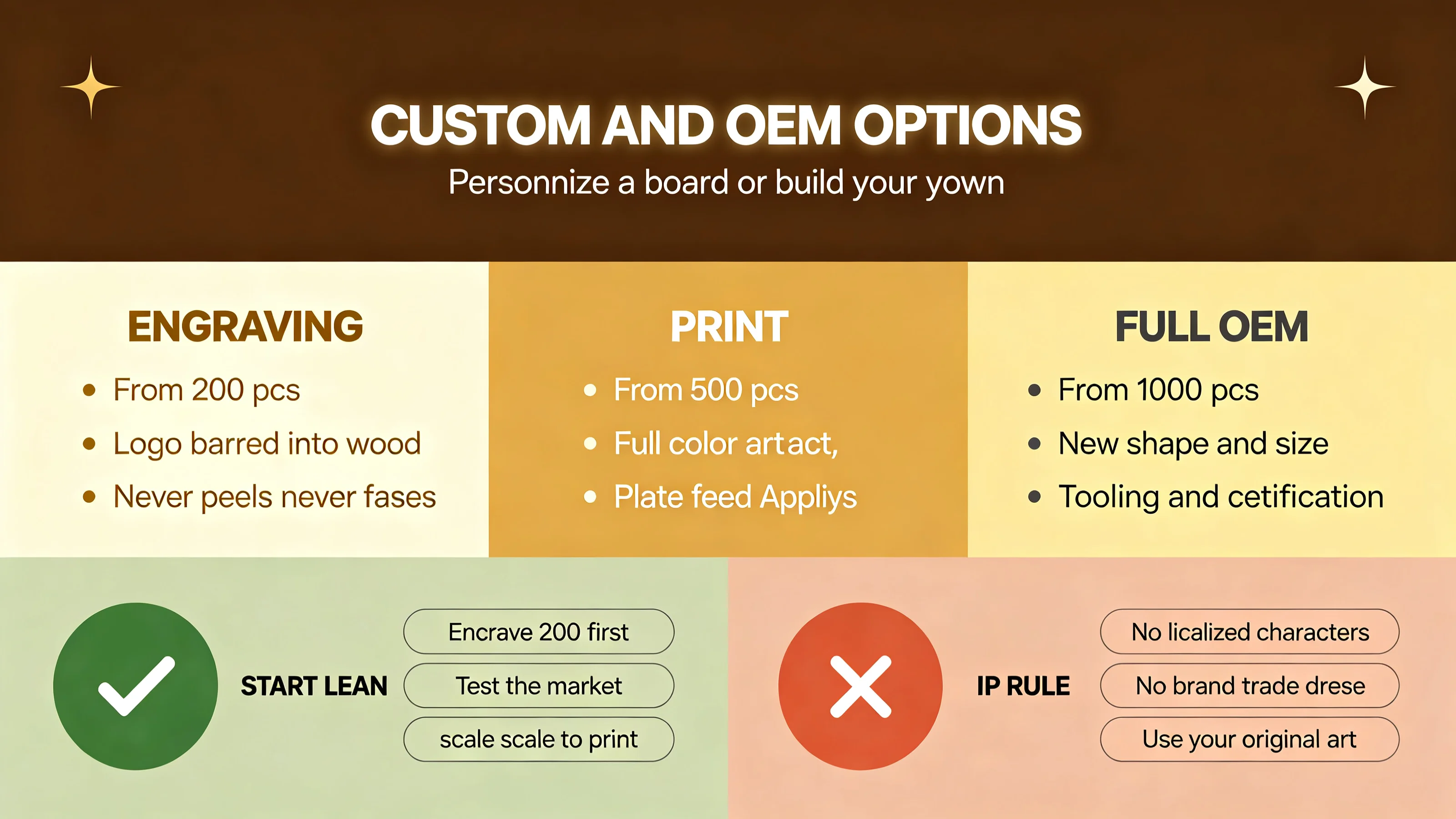
Short answer: if you sell under your own brand, you can put your name on a wooden busy board without paying for a new mould, and that is almost always the right first move. A personalized busy board works by layering your marks onto a board that already exists: engraving, print, colour, packaging, tags, paperwork. Each layer carries its own minimum order and its own small markup. Engraving typically starts at 200 pieces and adds $0.20–0.50 a unit; a printed gift box usually starts at 500. Changing the board itself, a new shape or a new switch housing, is a different project with a threshold roughly ten times higher.
We're a busy board factory in Wenzhou, and a growing share of what we ship is brand owners adding their name to a board we already make. Those orders are good business for us, and we'll tell you plainly where they get expensive, because that's the part that decides whether your range sells or fills a warehouse.
This guide stays on the personalization layer, the options and the thresholds. The end-to-end custom process, from brief to tooling, lives in our OEM and custom busy board guide, and we won't repeat it here.
Quick facts
- MOQ: 100 pcs from the catalogue · 200 pcs for engraving or your artwork · 500–1,000 pcs for full OEM
- Light personalization: engraving + your own hang tag + labelled white box, from 200 pcs
- Sampling: 1–10 pcs, 3–7 days, cost credited against the bulk order
- Lead time: 15–25 days after deposit and artwork approval
- Certifications: CE / CPC / ST reports on current models (tested to EN 71 and ASTM F963)
- FOB at MOQ: $8.90 Classic · $9.20 Alphabet · $9.50 Dino · retail target $20–35
The personalization layers on a personalized busy board
Ask ten buyers what they mean by "personalized" and most will show you a logo on a panel. In the factory that single idea splits into seven separate decisions, and they are not priced the same. The stack, cheapest and most common first:
| Layer | What changes | Typical MOQ | Typical add per unit |
|---|---|---|---|
| Laser engraving | Your mark burned into the panel or the back | 200 pcs | $0.20–0.50 |
| Screen or UV print | Colour artwork on the front or back panel | 500 pcs | $0.30–0.80, plus a one-off plate fee |
| Panel colour | Stain or paint change to the wood finish | 200–500 pcs | $0.15–0.40 |
| Switch mix | One switch type swapped for another | 300–500 pcs | $0.05–0.20 |
| Retail packaging | Printed box, window box, gift box | 500 pcs (gift box 500+) | often 30–50% over a plain box |
| Tag, sticker, manual, warranty | Added print items inside the box | 500–1,000 pcs per item | $0.03–0.15 each |
| Barcode and FNSKU | Your numbers on the box or a label | 100–200 pcs | a few cents or less |
Those ranges are real; the spread inside each one comes from quantity, material and how fussy the artwork is. Read the MOQ column as the point where the setup stops being wasteful, not as some arbitrary gate.
Laser engraving is the cheapest way to look like a real brand. It burns your logo into the wood, so it never peels, never fades, and survives a toddler. It also needs no ink, which keeps you out of chemical-safety trouble. If your identity is a wordmark or a simple silhouette, engraving does most of the work for a fraction of what print costs.
Screen or UV printing is what you graduate to when you want colour, a character of your own, or a full panel illustration. It gives you far more range and, in exchange, wants a print plate and a bigger run before it pays for itself.
Panel colour is the layer buyers forget and then miss. Staining the wood a consistent brand tone is cheap, and it makes your board recognisable on a shelf next to a plain pine one. The catch is that the factory can only run finishes it has already qualified. A new dye is a new chemical test, which is why colour and certification end up in the same conversation.
The switch mix is the layer most brands don't know they can touch. You can't rewire the board without turning it into structural work, but swapping a toggle for a rotary dial or a rocker so the front matches your product line is a light change, and it's priced like one.
Packaging, tags and paperwork are where a board stops being a board and starts being your product. A hang tag with your care instructions, a sticker on the box, a warranty card, a printed colour box with a window: each is a separate print item with its own minimum. We'll come back to packaging on its own, because it's the layer that surprises buyers most often.
Why personalization is not the same as full OEM
This is the distinction that decides your budget, so it's worth stating slowly. Personalization changes how the board looks. OEM changes what the board is.
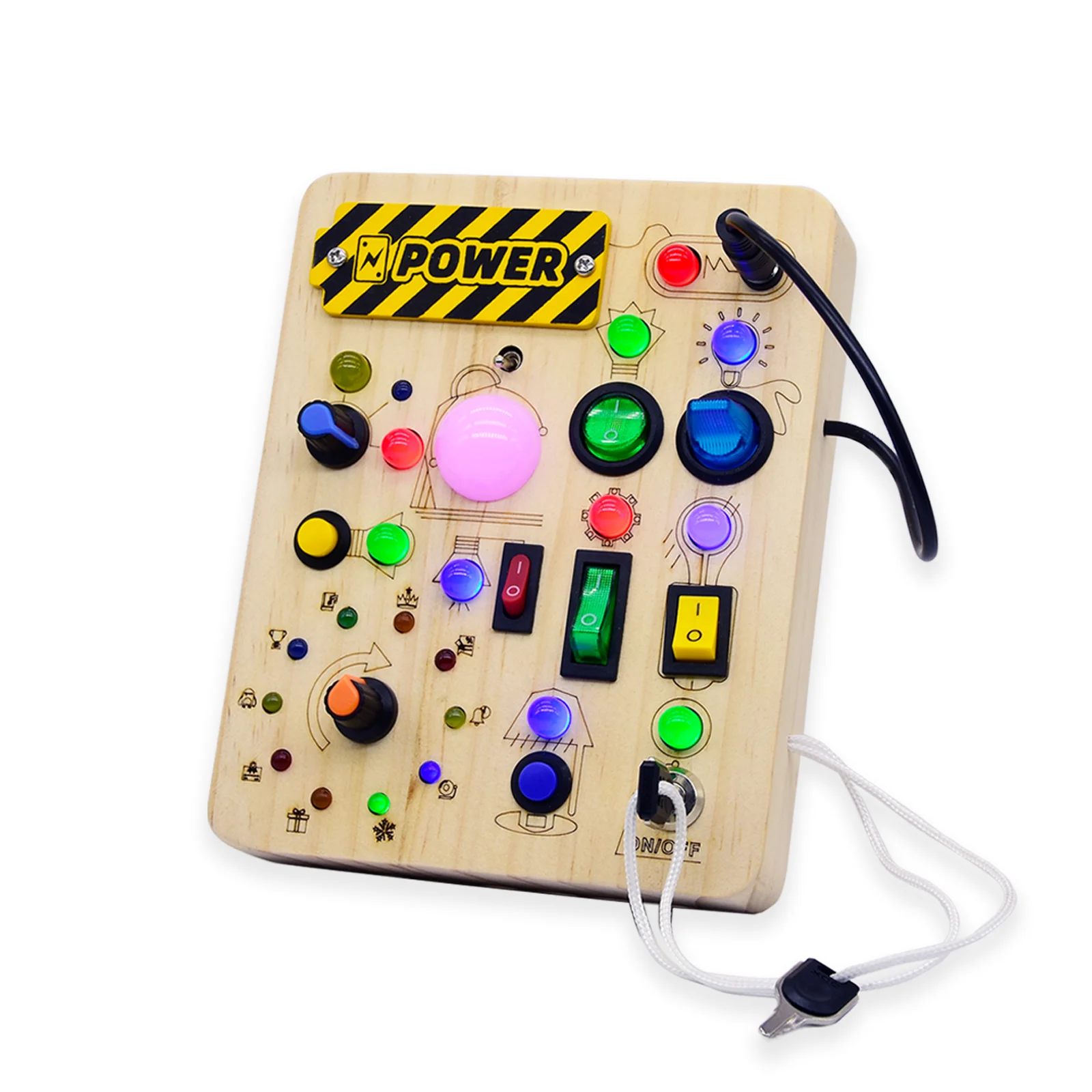
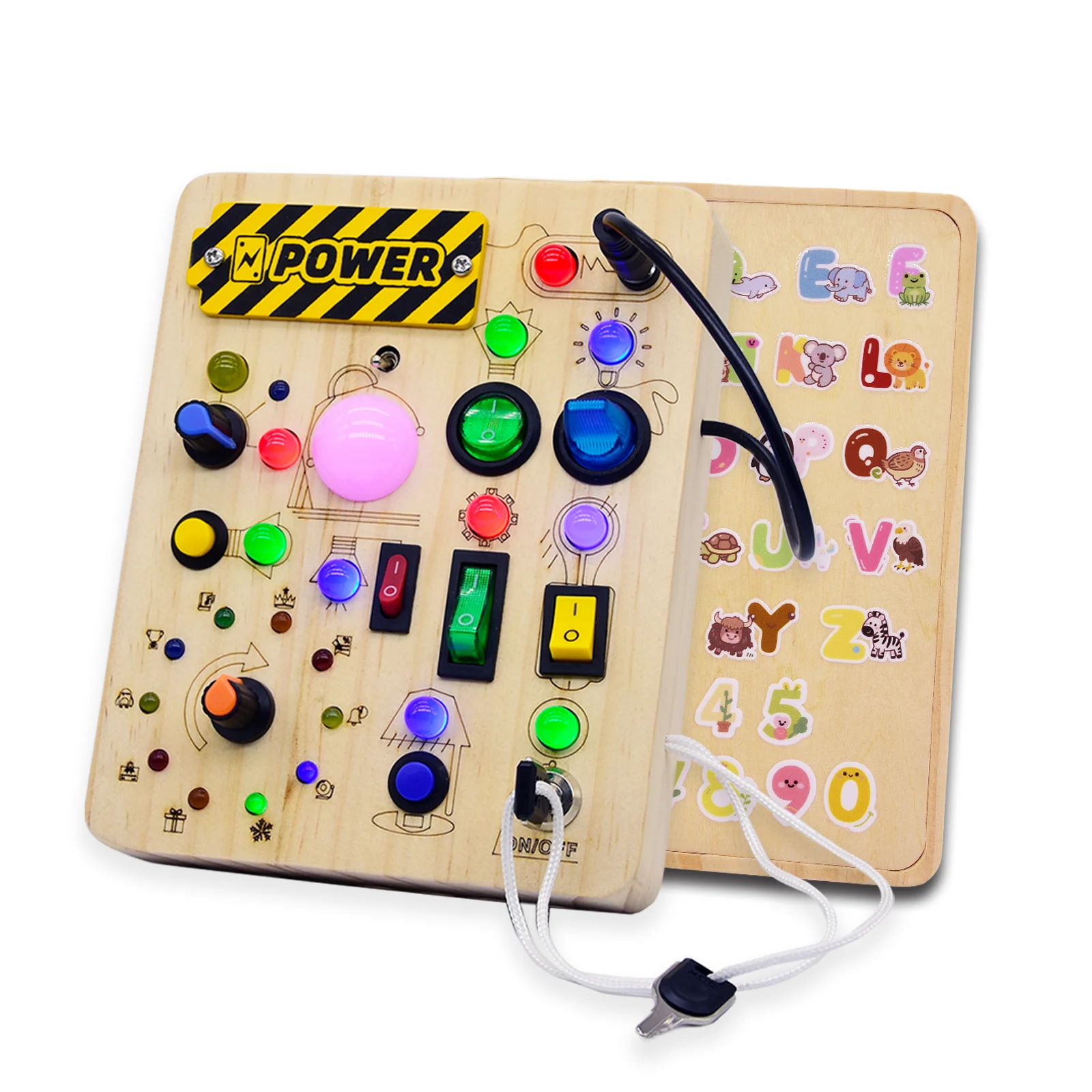
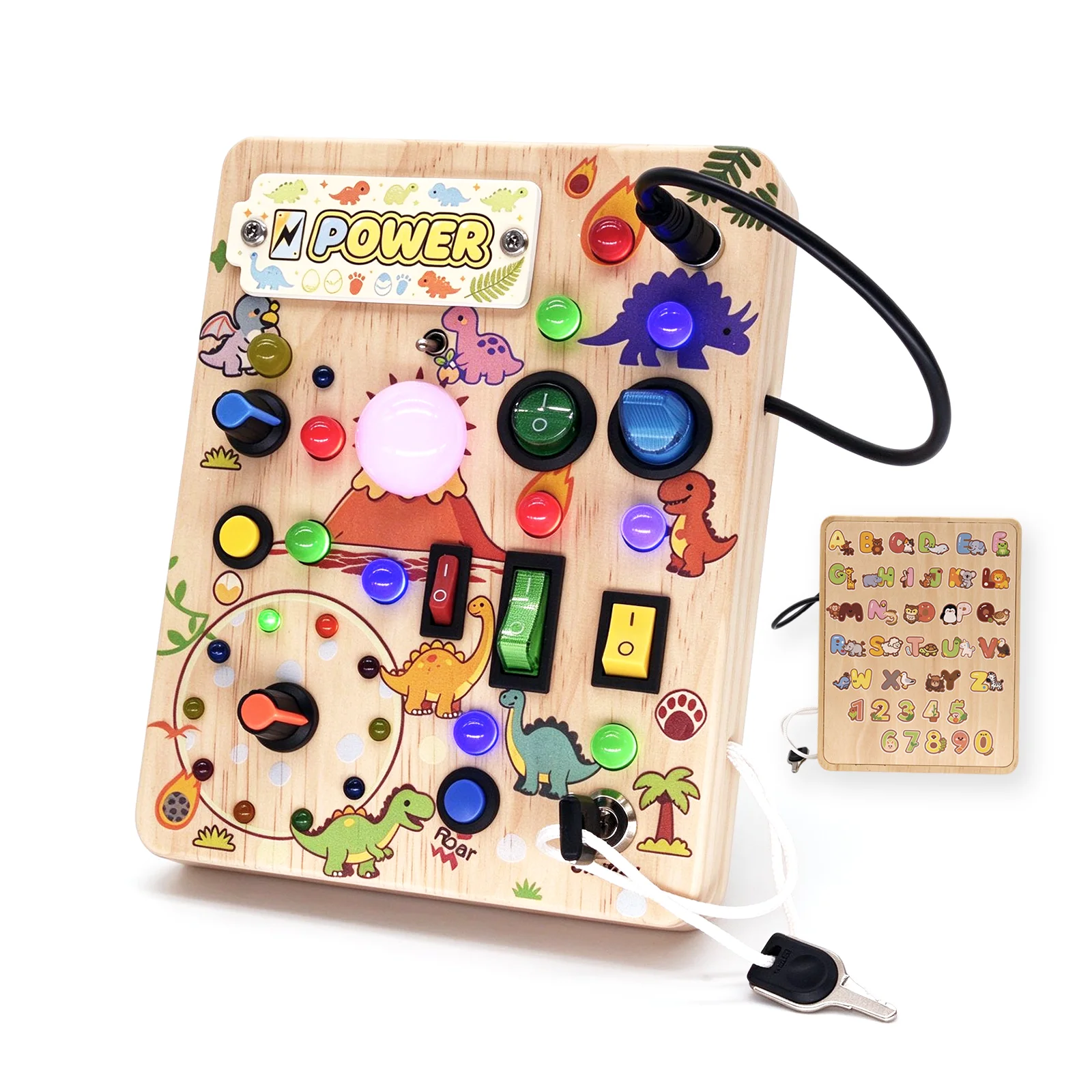
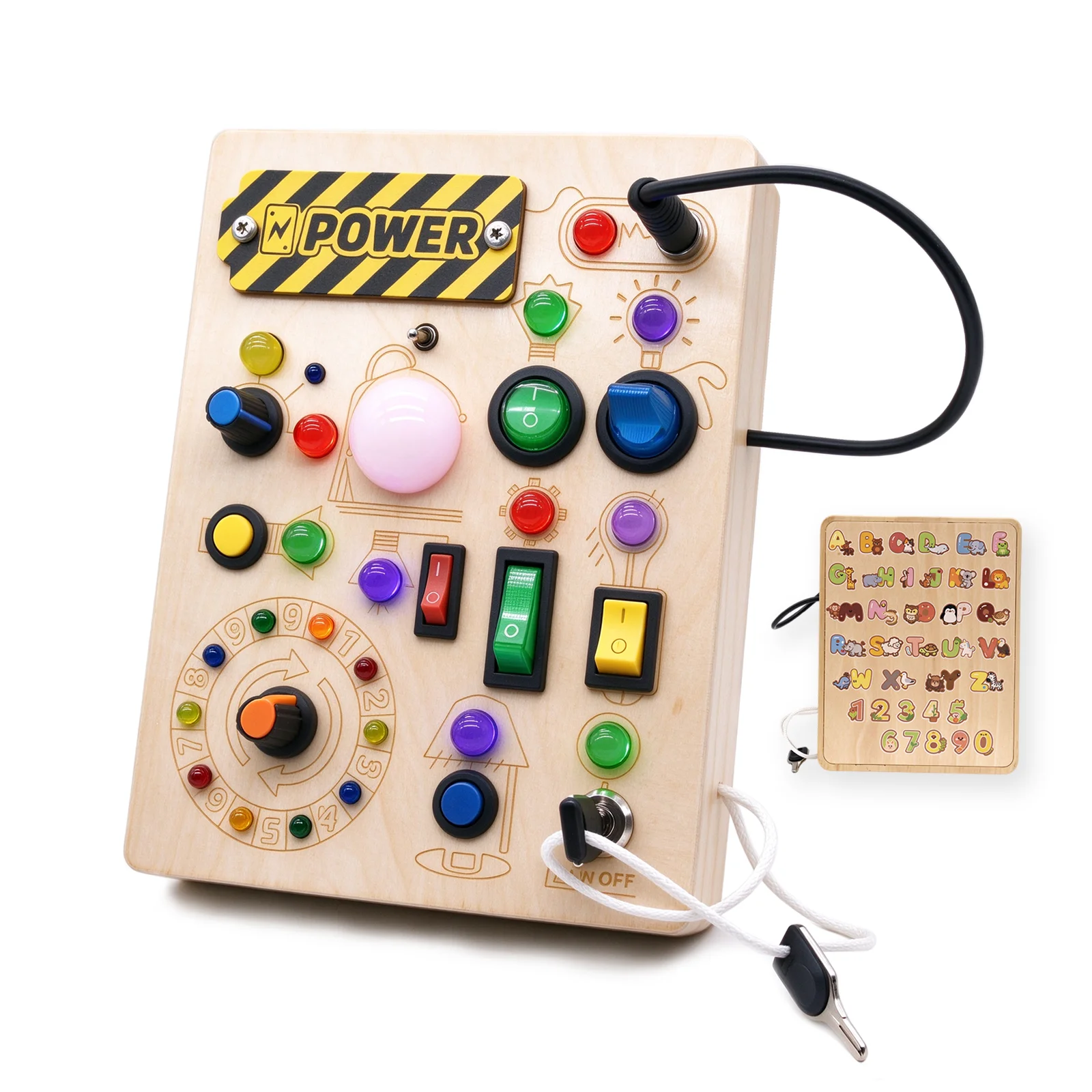
Everything a personalized busy board changes sits on the outside: what's printed or burned on the wood, what colour it is, what box it goes in, what paperwork sits beside it. The board underneath, the platform with its 12 switches and 23 lighting modes, stays the same.
OEM reaches the structure. A new silhouette, a new switch housing, a different board size, a mechanism we don't already run: that needs tooling or a bespoke cutting programme, a structural sample round, and fresh certification for the new configuration. Our own three boards share one platform precisely so a brand owner can personalize freely without paying for a mould on day one.
The practical consequence is the gap in minimums. Personalization starts around 200 pieces. Full OEM starts at 1,000, and often well beyond. That is roughly an order of magnitude, and it exists for a reason: engraving sets up a laser file, tooling sets up a production line. If a supplier quotes you OEM-threshold minimums for a logo, or personalization minimums for a new shape, one of those two numbers is imaginary.
What each layer costs, in practice
The table gives you the brackets. What it can't show is which layers carry hidden time. Two of them do.
Packaging first. A plain white box is included in our standard price. A printed box is not, and the jump is bigger than buyers expect. A full-colour retail box with an inner tray commonly adds 30–50% to packaging cost, before you count the die-cut tooling and the plate fees. A window box adds a material step on top of that. A rigid gift box, the kind that feels like a present in the hand, usually starts at 500 pieces and is the single most expensive option, which is why we push it toward brands that already know the product sells.
There's a second thing about packaging, and it isn't marketing. The artwork on the box carries legal weight: age grading, warning text and your details as the responsible operator all have to be correct and consistent with the certification file. Our packaging and shipping guide walks through the carton specifications; the point here is that a box redesign is a documentation change, not just a design change.
Then the paperwork and labels. Hang tags, stickers, manuals and warranty cards are cheap as individual items, often a few cents each, but each one has its own print run and its own minimum, and they add up. A brand that wants a tag, a manual, a warranty card and a FNSKU label on every unit is running four small print jobs, not one. Below 1,000 units we usually suggest consolidating: one printed hang tag that doubles as the warranty note rather than three separate items.
The barcode layer is nearly free and worth getting right the first time. Your own SKU barcode, or an Amazon FNSKU, can be printed on the box or applied as a label. Printed is cleaner for retail; labelled is far more flexible if you sell across several channels, because you can relabel stock that needs to move. Settle the number format before the box is printed, because reprinting a box over a wrong barcode is an expensive way to learn that.
Sampling: art approval is not structural sampling
With a personalized busy board, the sample you approve is usually a normal board carrying your engraving or your print, so it arrives fast and cheap. With an OEM board, the sample is a new physical object, and it takes longer and costs more. The differences are worth planning around:
| Personalization sample | Structural OEM sample | |
|---|---|---|
| What's new | Artwork and packaging | Shape, tooling, mechanism |
| Typical lead time | 3–7 days | 2–3 weeks |
| Sample cost | low, credited against the order | higher, includes a tooling share |
| Rounds to plan | one, sometimes two | two, budget for a third |
| Certification | usually unchanged | new reports may be required |
For the artwork itself, send vector files, AI, EPS or PDF, with fonts outlined and sized to the panel. Send Pantone references for colour, not "a warm yellow". A screen match and a Pantone chip drift apart by a few percent, and if that matters to your brand, say so up front and expect a press proof. If your file is a flattened JPEG pulled off a website, the engraver will be guessing, and so will you.
The approval loop is where personalization projects lose time. Going back and forth two or three times on placement, size and colour before the file is signed off is normal. Each round costs days, not dollars, and it's the reason a printed box can add a week that nobody put in the plan.
The IP line we won't cross
There is a version of personalization we get asked for constantly and turn down, and it's worth being blunt about it. We will not engrave a famous cartoon character onto a board. We will not print a design that copies a well-known brand's packaging. We will not reproduce a licensed image you don't hold a licence for.
This isn't us being precious. A toy carrying another company's protected character or trade dress is an infringement, and in our main markets that is the kind of problem that gets a shipment seized or a listing pulled. The factory printing it is exposed too. When a supplier cheerfully says yes to a Mickey Mouse engraving, what you've actually learned is that they'll take the order and the risk, and neither stays under your control once it's on a container.
If you want a character, draw your own, or licence one. A simple original motif, your own animal, your own pattern, your own mascot, engraves beautifully, costs the same, and can't be pulled off the shelf by someone else's lawyer. For a brand, an original mark is the whole point anyway. A borrowed one just makes you another reseller.
Three things brand owners underestimate about a personalized busy board
Most of the cost of personalization isn't the per-unit markup. It's three timing and risk items that never make it into the first spreadsheet.
The artwork and plate lead time
Deciding to personalize is the fast part. Producing the tooling to apply it is the slow part. A new print plate, a new box die, or a fresh laser programme each takes days to cut and test before production, and that time runs in addition to the 15–25 day production window, not inside it. A brand that approves artwork on Monday and wants goods shipped in two weeks has built a schedule around the one thing the factory can't rush.
The number of artwork rounds
First-time brand owners almost always plan for a single artwork review. In practice, placement and colour get adjusted two or three times, especially when more than one person at the brand has an opinion. Each round is cheap in money and expensive in calendar. Build one extra week into any launch that hinges on a new print or engraving, and you probably won't need it.
The dead-stock risk of a pattern that doesn't sell
This is the one that actually hurts. Personalization is a bet that people want your specific design. If they don't, you're not holding a neutral board you can sell to anyone; you're holding 500 boards with your logo and your colours that only you can move. Engraving and a neutral colour are relatively forgiving. A bold full-panel print of a mascot nobody recognises is not. The more specific the personalization, the smaller the first order should be.
Starting lean before you print a box
For a brand on its first order, the sensible stack is the cheap, low-risk end of the list. Engrave your mark, add your own hang tag, and put a branded sticker on the standard white box. That combination puts your name in the customer's hands, keeps the order at 200 pieces, avoids plate fees and box tooling, and tells you whether the product moves at all.
If it moves, the next step is a printed box and your own barcode. If it moves well, add the window or gift box, the full manual and the warranty card. The order matters because each step is a setup cost you pay once, and there's little sense paying for a box die for a product you haven't proven. This is also why the price curve in our wholesale price guide and the quantity tiers in our MOQ and lead time guide are worth reading together. The personalization you can afford is a function of the volume you can commit to, and nothing else.
Questions buyers ask us every week
Can I get custom engraving on a 100-piece order?
Occasionally, but not usually as a first run. Engraving needs a laser file and a setup pass, and at 100 pieces the setup is spread over too few units to be worth it for either side. Start at 200, or buy 100 plain to test and personalize the reorder.
Will my printed artwork change my certification?
It can. Any new ink, coating or dye on a children's product has to stay inside the chemical limits your EN 71-3 and ASTM F963 reports were based on. A colour that hasn't been tested is a risk, not a feature. Tell us the artwork before production so it goes into the test scope, rather than after.
How long does a printed box add?
Plan on one to two extra weeks for a new box: die-cut tooling, a plate, and a press proof. The printing itself isn't the slow part; the first-time setup is. Repeat orders reuse everything and lose almost all of that time.
Can you copy the look of a board I saw on Amazon?
If it's a generic design, we can match the style. If it's a specific brand's trade dress or a licensed character, no. We'd rather lose the order than ship something that gets seized or pulls your listing.
Do I have to take a full OEM order to look like a brand?
No, and this is the most common misunderstanding. Engraving, colour and your own packaging will make a board read as your product on a shelf, at a fraction of the OEM minimum. New tooling is how you change the product itself; the label you can change for far less.
What we'd do in your position
If you're launching your first personalized busy board, order 200 pieces: engraving, your hang tag, a labelled white box. Spend the money you didn't put into a box die on photography and a small ad test. The first job is finding out whether anyone wants the product at all.
If it works, come back for 500 with a printed box and your own barcode, and let the volume carry the printing. Keep the artwork in vector, keep your colours in Pantone, and keep one person as the final approver so the review loop stays short.
If you already know the product sells and you want a fully personalized busy board, box, insert, manual, warranty card, the whole shelf presence, send us the artwork, the target markets and a quantity. We'll quote the layers separately so you can see exactly what each one adds, and you can decide where your money is best spent.